
The AI Organization Needs Fewer Silos, Not Fewer People

Picture one customer with a damaged order and a suspicious refund. Support gathers the complaint. Finance checks the payment. Fraud reviews the account. Operations traces the shipment. Each team may move quickly, but the customer still has one problem and waits through four queues.
Now give every department an AI assistant. Support gets a first-pass summary and options in minutes to hours, depending on the task and the system. Finance reconciles the transaction. Fraud spots the odd pattern. Operations traces the package. The work gets faster inside each function, yet nobody can finish the case without sending it through the same four queues.
That is the organizational problem hiding inside many AI programs. When people can see more of the work and handle more of it, authority has to travel with capability. If it does not, a more capable employee just becomes a faster human router.
Faster tasks can still produce a slow company
AI can move practical knowledge closer to the person doing the work. Support research gives us a concrete example. In the National Bureau of Economic Research paper Generative AI at Work, access to an AI assistant increased issues resolved per hour by 14 percent on average and by 34 percent for novice and lower-skilled workers. The researchers found suggestive evidence that the tool spread communication patterns used by stronger performers. Experienced, highly skilled workers saw little productivity effect.
One company, one support operation, and one tool cannot settle what happens to wages, total labor demand, or future hiring. The narrower lesson belongs in everyday work: practiced knowledge can reach a colleague while the customer is still waiting, rather than sitting behind another request for help.
PwC calls the broader shift role convergence. Work that once required several narrow roles can collect inside a broader one as AI lowers the effort needed for analysis, coding, writing, and financial modeling. Capability can cross a departmental boundary long before decision rights do. Then an employee sees the answer but still cannot act on it.
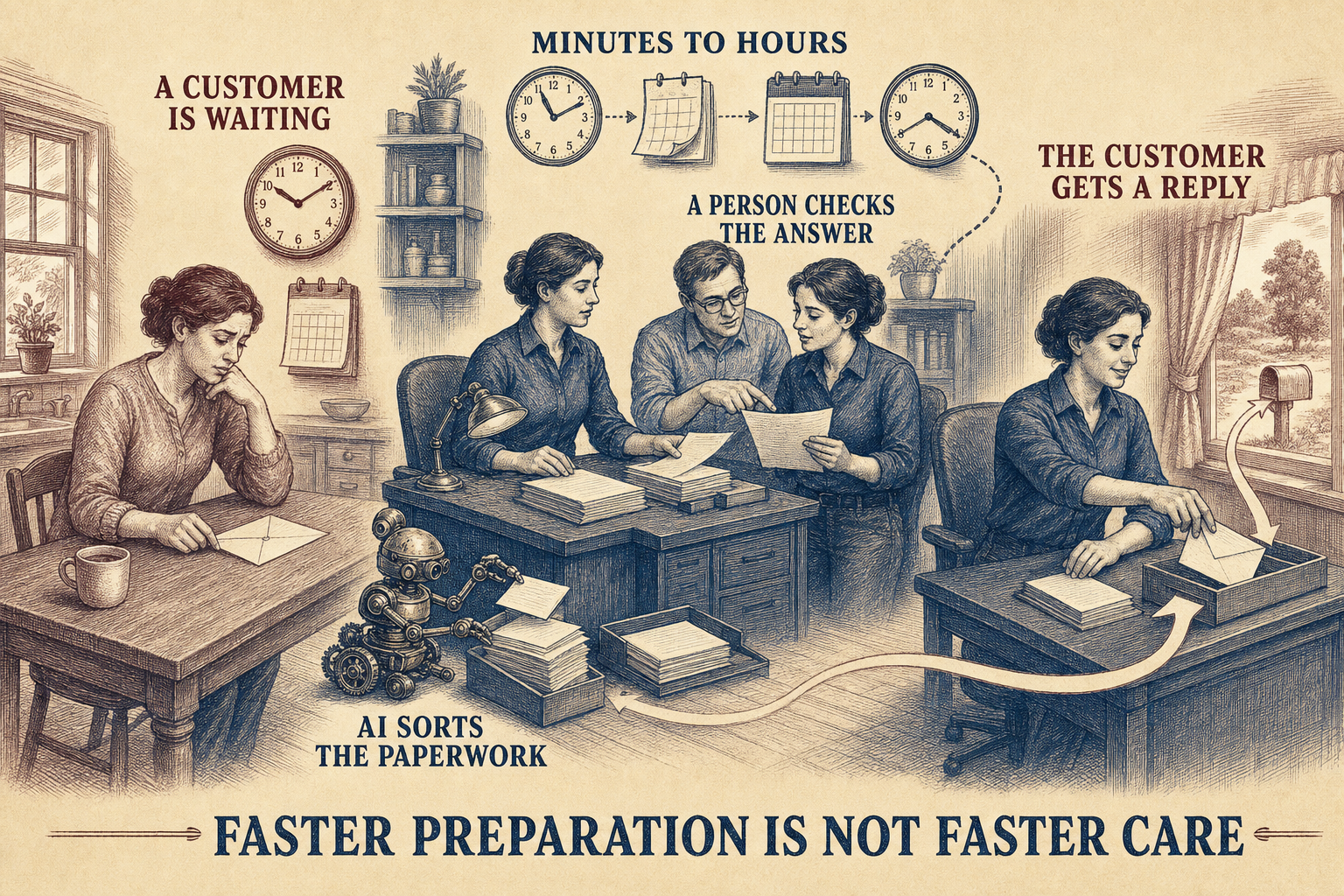
This is the org chart as a rate limiter in practice. The model may return a response in minutes to hours. The company can still take days to decide whose response counts.
The customer waits in the handoff
Specialization is not the enemy. A fraud analyst should know more about fraud than a support agent. A finance partner should understand the controls around refunds. The trouble starts when the organization turns that judgment into a relay race.
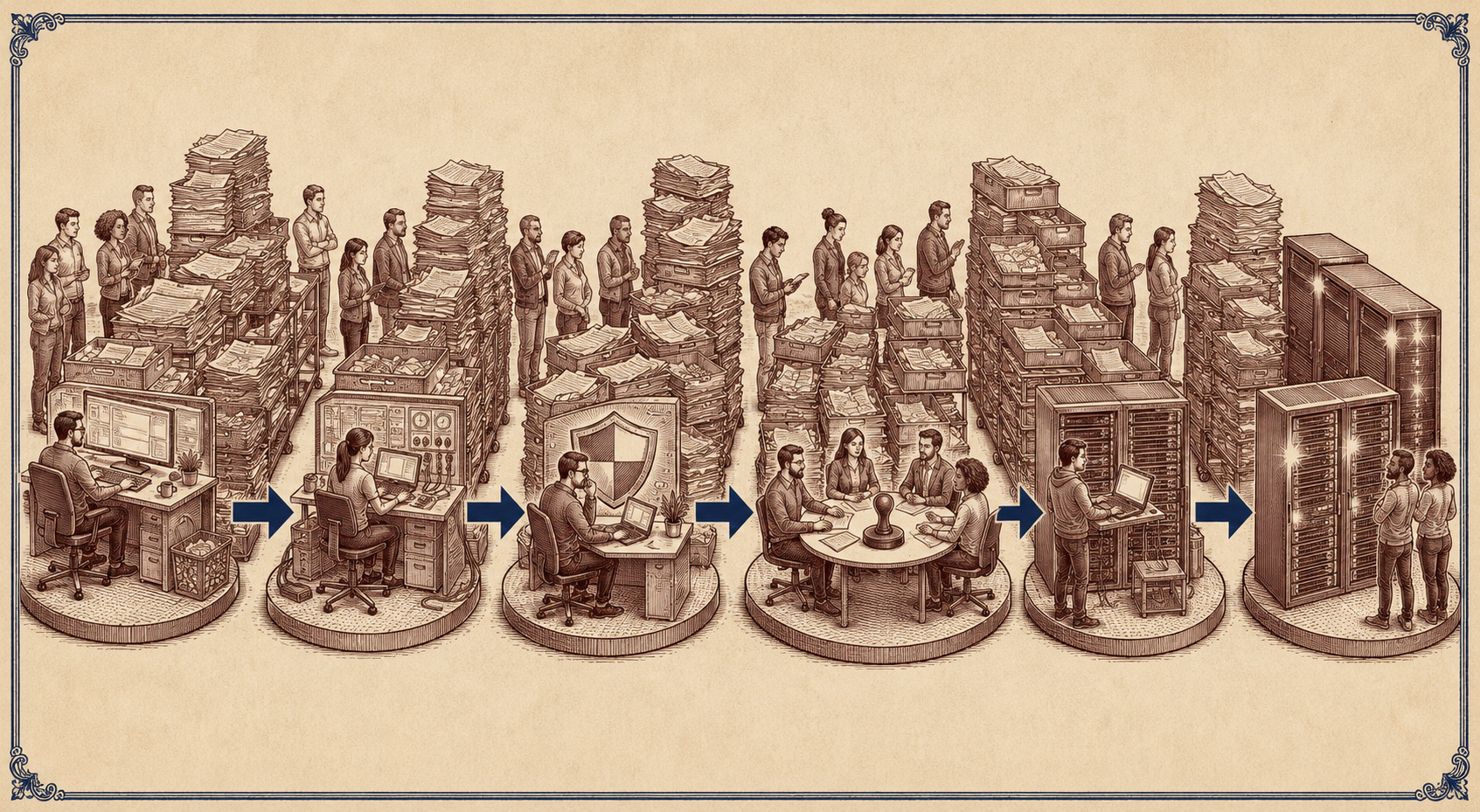
A value-stream map follows one piece of work from request to outcome. It records the work that changes the service, the information that moves it along, and the time each step takes. The Lean Enterprise Institute defines it as a map of the material and information flows needed to deliver a product or service. In software, the material is often a change, a case, or a decision.
Start with the distinction between processing time and lead time. Processing time is the work itself. Lead time includes the waiting. That waiting is inventory: unfinished work sitting in a queue, an inbox, a ticketing system, or someone's memory while the next specialist becomes available.
There is no honest universal number for how long a handoff should take. The evidence shows how large the gap can become. In a State Farm case study, leaders reported about 1,500 hours, nearly 150 steps, and 35 handoffs to move one production activation in 2015. They later described reducing delivery from two or three weeks to two or three hours. That is one organization's measured experience, not a benchmark for every software team. It is still a useful warning about what a queue can hide.
DORA recommends mapping the flow from idea to production and reporting lead time, process time, and the percentage of work completed accurately. Those measures put a number on the space between teams. They also change the question. Instead of asking which department needs an AI assistant, ask where the customer waits and who has the authority to remove that wait.
Microsoft's 2025 workplace telemetry offers a view of coordination at its noisiest. The top 20 percent of Microsoft 365 users by ping volume received 275 interruptions from meetings, emails, and chats per day. Among the top 20 percent by meeting volume, 60 percent of meetings were unscheduled or ad hoc. The telemetry excluded education and European Union tenants.
Those are not average-worker numbers, and every interruption is not a handoff. The pattern should feel familiar if you have watched a simple decision bounce among inboxes while the person waiting for it hears nothing.
Return to the damaged order. The team can assemble the complaint, shipping scans, payment history, and policy in one place. AI can draft a sensible remedy. Then a refund threshold sends the case to Finance, the suspicious transaction sends it to Fraud, and the replacement order sends it to Operations. Each function asks for the facts in its own format. The support rep keeps updating an unhappy customer while the manager chases three queues they do not control.
No one in that chain has to be slow or careless. Finance can hit its service target. Fraud can complete a sound review. Operations can ship quickly after approval. The customer can still wait too long because nobody owns the elapsed time. Support absorbs the anger, specialists lose focus to repeated context switches, and the manager adds another meeting to hold the pieces together.
AI does not fix that design. It can make the pile of drafts, summaries, and recommendations grow faster against the same approval gates.
Keep specialist judgment. Stop renting it by ticket.
Fewer silos does not mean everyone does everything. Security, finance, legal, safety, clinical practice, and deep engineering need people with the standing to challenge a delivery team and stop work when the risk is real.
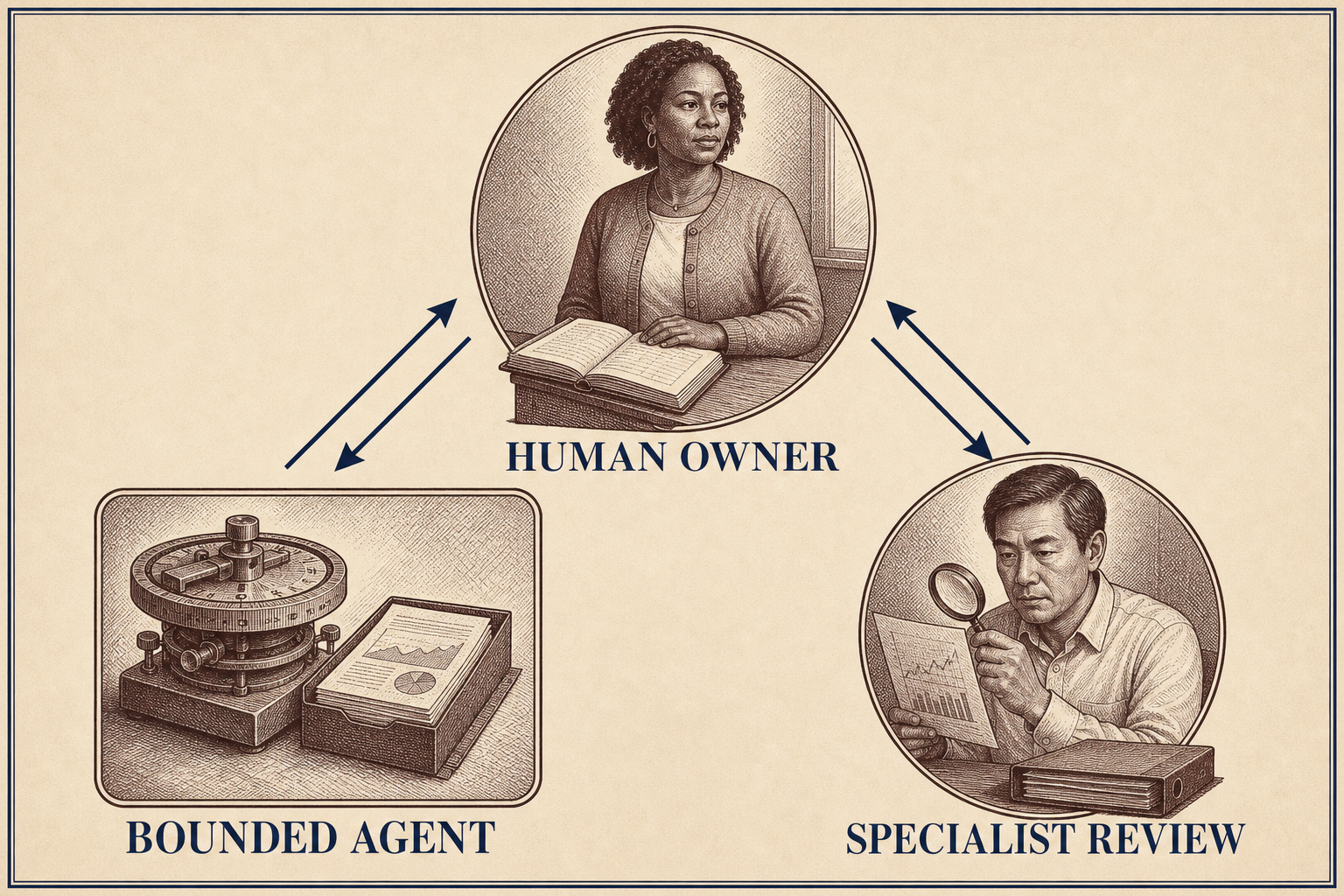
The operating boundary should be plain enough to use on a busy Tuesday. A customer team might resolve an ordinary damaged-order refund under an agreed policy without opening three tickets. A request to change the refund policy is different. So is a case with material fraud, legal, safety, or customer-harm risk. Those decisions need specialist review because their consequences extend beyond one customer.
Write down what the team may decide, what record it must keep, when a specialist enters, and who can stop the work. Set a response expectation for that review, too. Control without a clock is often just an abandoned ticket with a more respectable name.
That boundary is why AI governance is human work. A machine can surface an answer. A person still owns the choice to act, escalate, or refuse.
Do not smuggle a layoff plan into redesign
Leaders can poison this work before it starts. They announce a productivity program, ask employees to document everything they know, and quietly convert the expected gain into a headcount target. That is not organization design. It is a payroll decision wearing an AI badge.
Ingka Group made a different choice when routine customer work shifted. The company reported that its Billie assistant resolved about 47 percent of the inquiries it received from 2021 through 2023. Ingka also said it reskilled 8,500 call-center co-workers for remote interior design, digital sales, relationship building, and complex inquiries.
Those are Ingka's own figures, not an independent causal evaluation. They do not prove that reskilling produced the company's sales results or that every employer can repeat the move. They show that management had a choice. When routine work changed, people could move toward work that needed context and judgment instead of being treated as the next cost to cut.
The wider labor picture is unsettled, not empty. PwC's 2025 analysis of job advertisements reported growth from 2019 through 2024 in both groups it studied: 38 percent in more AI-exposed occupations and 65 percent in less-exposed occupations. Jobs requesting AI skills carried a reported 56 percent wage premium over similar roles without those requirements.
Job-ad data cannot prove that AI caused the growth, tell us whether current workers benefited, or predict the next labor cycle. There is room for displacement, weaker entry-level hiring, work intensification, and wage pressure. Exposure and extinction are not synonyms.
The warning in the AI hiring reversal applies here: positions removed are an accounting result. They do not tell you whether customers got better service, employees learned harder work, or the company became more capable.
Managers decide what capacity becomes
An AI policy does not tell an employee what to do at 10:17 on Tuesday morning after the assistant finishes a first draft and the queue is still full. Their manager does.
In Gallup's 2026 U.S. analysis, employees who said their manager actively supported team AI use reported 48 percent engagement, compared with 30 percent among employees who did not say that. Organizations with a clear AI integration plan showed a 15-point engagement advantage in the same Gallup analysis.
Gallup found an association, not proof that manager support caused the difference. A healthier organization may be better at both management and AI adoption. The management work is concrete either way: decide which task leaves the queue, where the saved time goes, what good work looks like, and when a human must slow things down.
Boston Consulting Group found the same gap from another angle. In its 2026 survey of nearly 12,000 workers, managers, and leaders across more than a dozen markets, 67 percent said AI had taken over simpler tasks, and 72 percent said skill expectations had changed. Only 36 percent said they had received adequate upskilling. Among regular frontline users, 66 percent reported limited or no guidance about what to do with time saved.
Saved time is a management decision. Does the team handle more volume, spend longer on difficult cases, learn a new skill, or finally stop doing work nobody values? If the answer is “do everything you did before, plus AI,” the likely result is not transformation. It is a faster path to exhaustion.
Redesign one stubborn outcome
If you lead this work, do not begin by flattening the chart. Pull a small set of recent cases that crossed several functions. Put a manager, a frontline employee, and the relevant specialist partners around the same table. Trace every wait, repeated request, correction, approval, and moment when the customer had no answer. Use the case history, not the process diagram everybody knows is fiction.
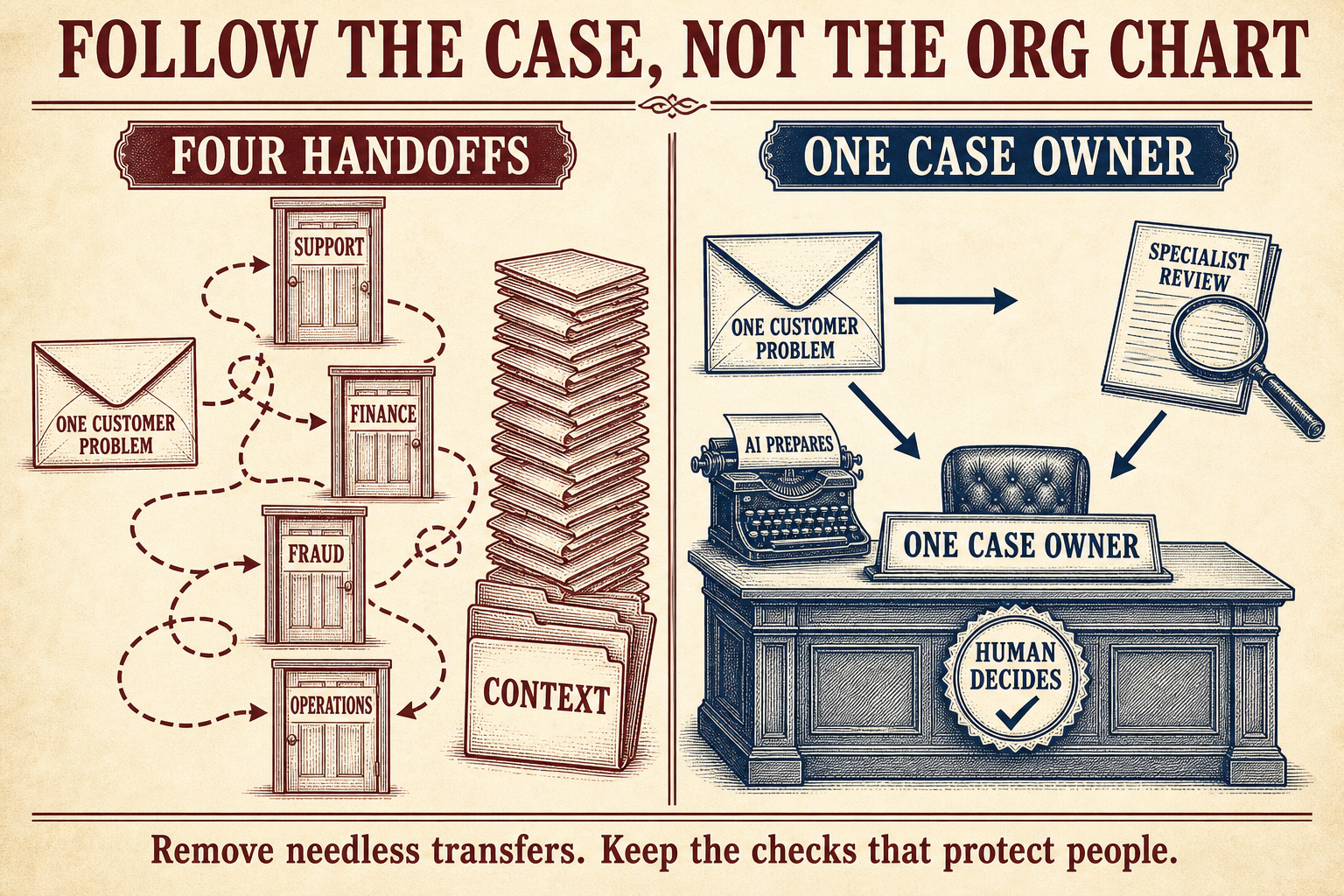
Put one human name on the outcome and give a stable team enough authority to handle ordinary cases inside agreed limits. For material risk, name the specialist partner and set a response time. Nobody should have to convene a temporary committee each time a case bends.
Judge the change by the whole trip: customer outcome, elapsed time, rework, defects, control failures, employee learning, and after-hours spillover. Run the redesigned path beside the old one long enough to see what breaks. Expand it only when customers get a better result and the people doing the work gain clearer authority without losing necessary challenge.
Even AI suppliers are organizing around this reality. IBM and OpenAI announced forward-deployed units that combine engineers, consultants, security specialists, and domain experts inside client workflows. Their announced operating models are not independent evidence of customer results. They acknowledge the shape of the problem: implementation has to cross the same functional boundaries the technology just blurred.
Move authority with capability
A leaner workflow is not the same thing as a thinner payroll. The real goal is a shorter distance between a customer's problem and the person accountable for resolving it.
AI can help expertise travel. It cannot decide where authority belongs, which risks deserve an independent challenge, or what people should do with the time they get back. Leaders and managers still own those choices.
Move the walls that make customers wait. Keep the people and the checks that make good judgment possible.