
Your Org Chart Is Your Rate Limiter: Why AI Transformation Depends on Organizational Infrastructure

95 percent of organizations get zero return from generative AI.
The models can work. The data can be ready. And the pilot can still go nowhere, because the organization around it can't absorb what artificial intelligence (AI) produces.
That isn't a hunch. A 2025 MIT Project NANDA report, based on interviews, surveys, and 300 public implementations, found that 95 percent of organizations received no return from generative AI. Only 5 percent of integrated pilots extracted millions in value. Most showed no measurable profit-and-loss (P&L) impact. The report points to brittle workflows, weak contextual learning, and poor fit with day-to-day work. In other words, the technology can work while the organization around it fails to make use of it.
This problem is easy to misdiagnose. It looks like a tooling gap, so companies go shopping. New platform, same org chart, same stalled adoption.
Harvard Business Review arrived at the same place in late 2025: people, processes, and politics derail AI initiatives more often than the technology itself.
The Causal Chain
The path from org chart to AI outcome isn't mysterious. It runs through four connected constraints: team boundaries, decision rights, feedback speed, and platform adoption. Slow any one of them, and the whole transformation slows with it.
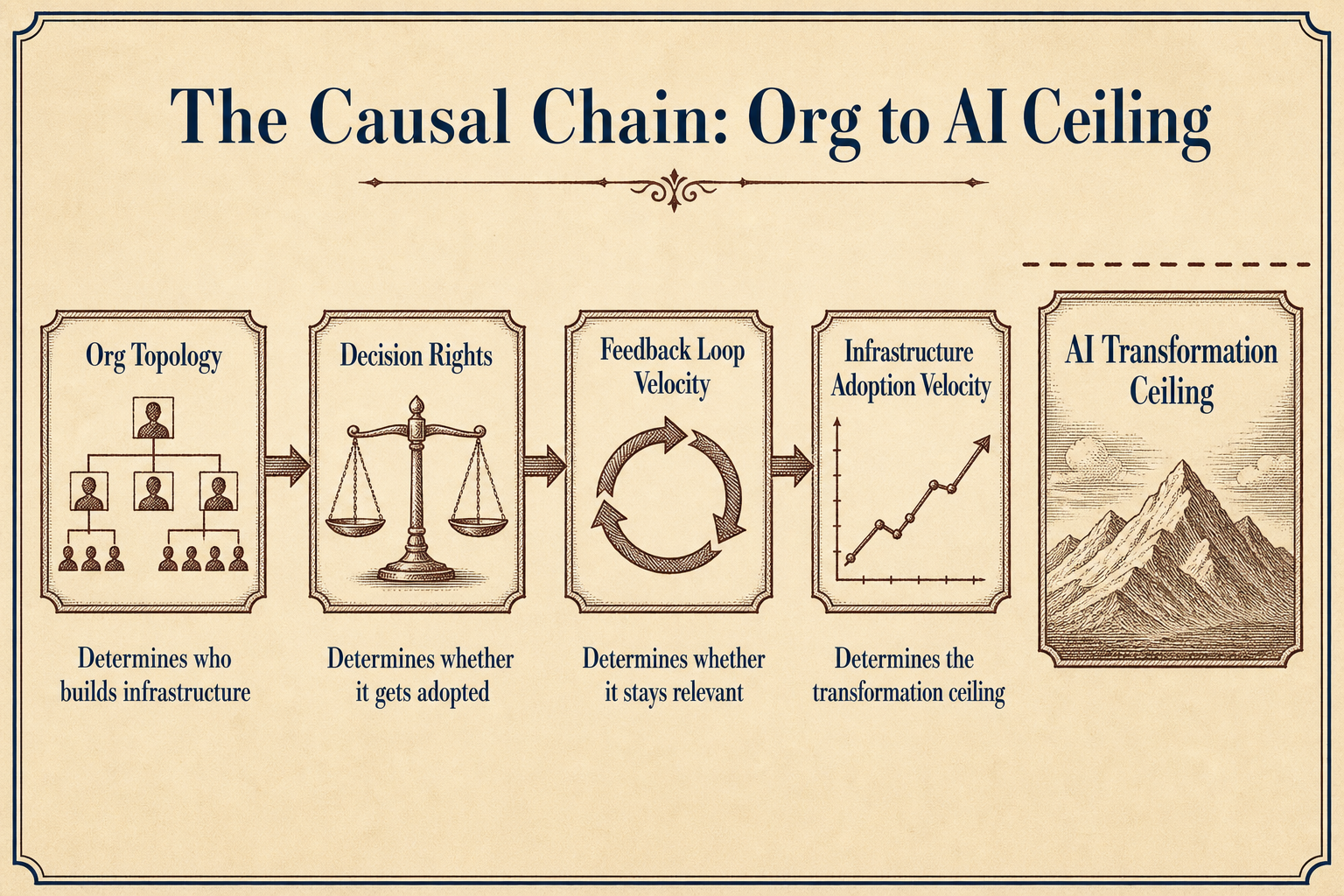
The first constraint is team topology. Conway's Law says organizations produce systems that reflect the way their people communicate. Mel Conway's original 1968 paper established the relationship, and later empirical research found it across multiple industries. Centralize the AI team, and the infrastructure tends to centralize with it. Federate the team without shared boundaries, and fragmentation follows. Team structure shapes architecture.
Decision rights come next. A 2026 ClarityArc analysis warns that an AI Center of Excellence (CoE) can become the bottleneck it was meant to prevent. The reason is mundane: the CoE controls platform standards, but product teams own delivery. One side needs governance. The other needs speed. Split those decisions badly, and adoption stalls. Microsoft's Cloud Adoption Framework recommends moving the CoE away from centralized control and toward an advisory role as the organization matures.
Then there's feedback. Machine learning operations (MLOps) principles connect model delivery with automated validation, deployment, monitoring, and retraining. That adds concerns such as data drift, retraining triggers, and feature pipelines to an already crowded software-delivery loop. If the platform team releases quarterly while the product team needs hourly retraining, the org chart has already picked the winner.
The last constraint is platform adoption. The 2025 DevOps Research and Assessment (DORA) report describes AI as an amplifier. It magnifies what an organization already does well, along with everything it does badly. DORA's platform engineering research found that a high-quality internal platform turns AI adoption into stronger organizational performance. With a weak platform, the effect is negligible.
The Build-It-and-They-Will-Come Fallacy
Build a good platform, and people will use it. That sounds reasonable. It also fails often enough that DORA gives it a name: the "build it and they will come" trap. Teams build from assumptions, skip user research, and discover too late that their platform doesn't fit the work. Platform Engineering.org recommends the opposite: map stakeholders, establish baseline metrics, and put an eight-week minimum viable product (MVP) in front of a real team.
The CoE Trap
The bottleneck moves up the org chart, too. The AI Code Generation Paradox shows how faster coding exposes slower testing, review, and deployment. A Center of Excellence can do the same thing at organizational scale: accelerate experimentation, then become the queue every team has to wait in.
Don't abolish the CoE. Give its centralized authority an expiration date. The Executive Enthusiasm Gap explains part of the problem: leaders fund AI infrastructure without funding the organizational change needed to absorb it. A CoE can cushion that transition, but it can't remain both accelerator and brake.
What Works
The evidence doesn't point to one perfect org chart. It points to three practical moves.
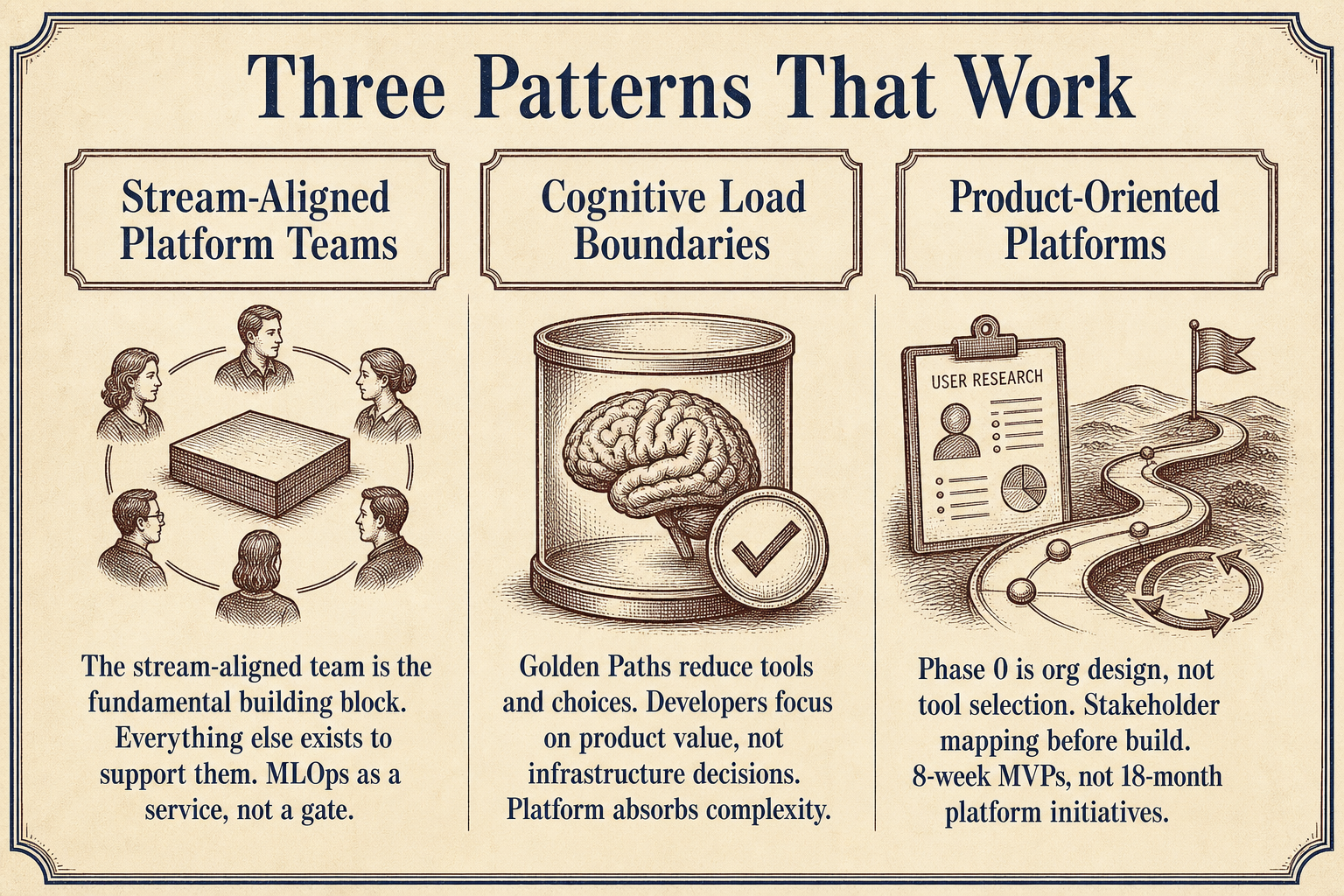
Put delivery close to the work. Team Topologies defines four fundamental team types: stream-aligned, platform, enabling, and complicated-subsystem. For AI delivery, the stream-aligned team owns the machine learning models, application programming interfaces (APIs), and product experience. Platform teams take infrastructure complexity off its plate. Enabling teams lend expertise for a while, then move on. Work that truly demands specialists, such as graphics processing unit (GPU) optimization or real-time inference, belongs with a complicated-subsystem team. The point isn't the labels. It's keeping the team that owns the outcome in motion.
Protect people's attention. Platform engineering research traces how DevOps added operational responsibility to developers' already crowded jobs. Golden Paths help by narrowing the number of tools and decisions a team has to carry. A good platform absorbs complexity. It doesn't hand developers a better-organized pile of it.
Build the platform like a product. The four-phase approach starts with discovery: stakeholder mapping and baseline metrics before anyone chooses a tool. Then it puts an eight-week MVP in front of a real team. That feedback is worth more than eighteen months of steering-committee approval.
The Org Chart Is the API
Think of the org chart as an application programming interface (API) for the company. It defines who can talk to whom, who gets to decide, and how quickly feedback travels. The Dark Factory scenario, where AI systems build AI systems without human intervention, only makes those connections more important. Automation doesn't dissolve organizational coupling. It hardens it. Machines build what the organization asks for, including its fractures.
That is the useful reading of MIT Project NANDA's finding. The models aren't the whole story. The org chart decides who can act, how fast learning travels, and whether a working pilot becomes normal work. Leave those connections frozen, and the transformation ceiling stays frozen too.