
Digital Twin Engineering: Test APIs Fast Without Blowing the Bill

Your software team is getting faster. That is the promise of agentic engineering: people and software agents can write, change, and test code in short cycles.
Speed creates a new problem. Integration tests can hit partner APIs, vendor systems, shared development accounts, and lower environments far more often than production traffic ever will. Those systems may charge per request, limit traffic, or react badly when a small test environment starts behaving like a busy customer.
A team needs a place to learn before it touches those systems. That place is a digital twin.
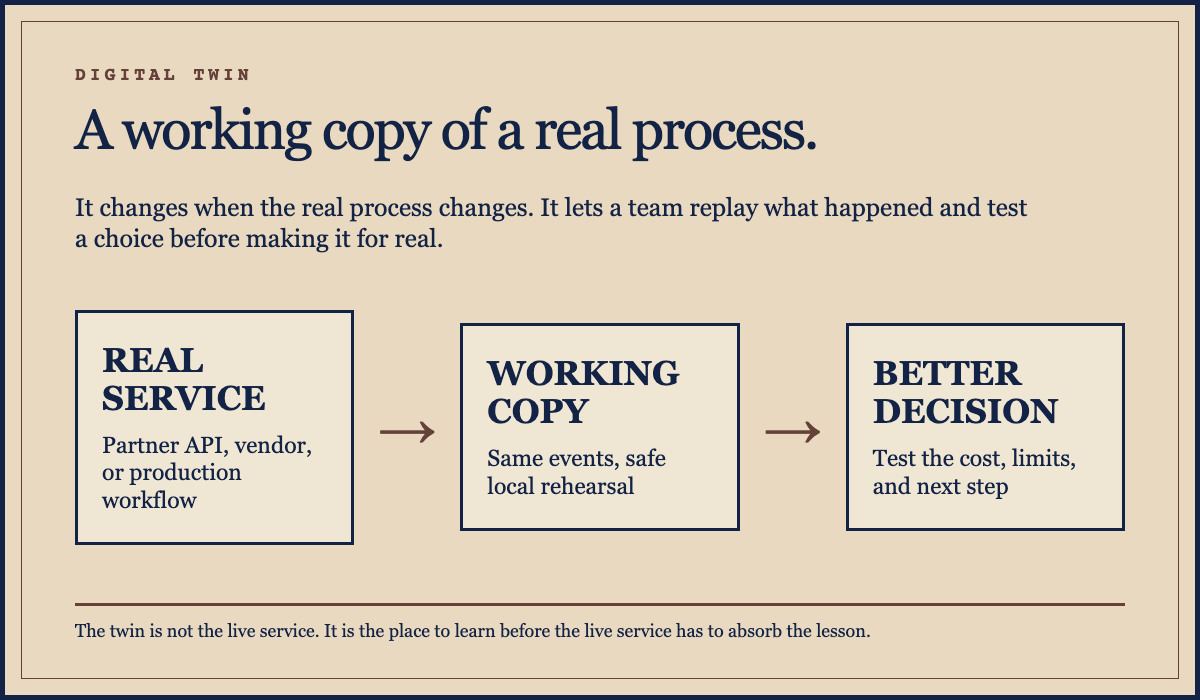
Digital twin is a core capability for agentic engineering
A digital twin is a working copy of a real thing or process. It changes when the real thing changes. It lets a team replay what happened and test a choice before making it for real. The National Institute of Standards and Technology describes digital twins as electronic representations that show an entity's state and the changes between states.
That definition is simple on purpose. A digital twin is not a dashboard. A dashboard shows you what happened. A twin lets you use that record to ask what might happen next.
Groktopus treats digital-twin capability as a core part of a governable software factory. You cannot build a truly useful factory if every experiment must touch a live partner, spend against a paid service, or wait for a production incident to reveal a bad assumption.
We released a free digital-twin agent skill to give teams a starting point. It is a guide for building the working copy, checking its evidence, and deciding when it is allowed to influence the real system. It is not a certification, and it does not make those decisions for you.
The useful word here is rehearsal. The rehearsal is not a second product. It is what the digital twin lets you do: practice the workload, inspect the result, and reserve live calls for the questions that only the real provider can answer.
Why faster coding strains the systems around your code
When agents help produce more changes, your tests have more work to do. The pressure shows up in three places.
- Partner systems: a vendor may see a flood of requests that looks nothing like normal use.
- Test environments: a small development service may receive more traffic than it was sized to handle.
- Your bill: a provider may charge for every billable event, even when the call exists only to answer an early engineering question.
Google's Places API is a clear example. Its Text Search documentation explains the field-mask rule: the requested fields determine the billing level. Google also sets quotas per API method and project, as its usage and billing rules explain. The cost still grows when the traffic grows.
The usual answer is to test less. That slows learning and hides risk. The better answer is to move broad exploration into the twin, then use a small live check to test the assumptions that only the provider can prove.
That is the same reason leaders need to judge the economics of a pilot before scaling it. The first request is not the whole cost. Repetition is where the operating bill appears.
One concrete example: price the calls before you make them
To make the idea concrete, we built a small local model of a fictional Coffee Finder service. A user searches for coffee shops. The application would normally ask Google Places Text Search for a place name and formatted address.
The local fixture contains synthetic request records shaped like this:
{
  "time": "2026-08-12T14:03:27Z",
  "kind": "places.text_search",
  "query": "coffee near downtown",
  "field_mask": ["places.displayName", "places.formattedAddress"],
  "mode": "synthetic"
}
The record is not a Google request. It is a safe description of the request the application wants to make. The model can count those records, replay them, and apply a published price without sending the whole test run to Google.
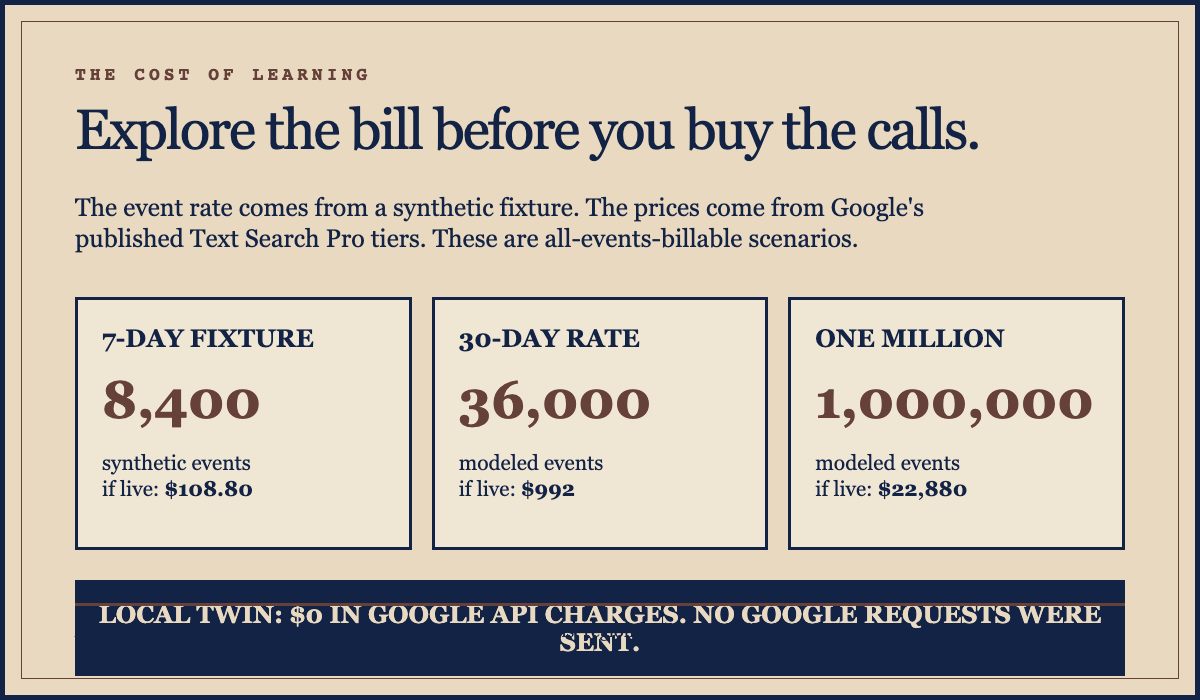
Google's current pricing list gives Text Search Pro a 5,000-event free cap, then charges $32 per 1,000 events in the first paid tier. The published pricing table shows the later volume tiers as well.
Using that price table:
8,400 synthetic events over 7 days
If every event became billable: $108.80

36,000 modeled events over 30 days
If every event became billable: $992.00

1,000,000 modeled events
If every event became billable: $22,880
Those are all-events-billable scenarios. The fixture contains generic errors without the response codes needed to price each event exactly. A real bill could differ. The point is not to predict an invoice from a toy dataset. The point is to see the scale before buying the calls.
The rehearsal environment never called the official Google API. It only used the digital twin, so the Google API cost was $0. That is the cost of this rehearsal, not a claim about what a production system would cost.
What the free digital-twin skill helps you do
Cost rehearsal is only one use. The free digital-twin skill describes a broader set of jobs in simple terms:
- Replay history: look back at what happened and try a different response.
- Test a change first: compare a new rule or workflow with the current one before using it live.
- Spot bad information: flag records that are stale, late, missing, or in conflict.
- Separate kinds of failure: tell the difference between a sick service, bad data, a weak model, a broken platform, and unsafe agent behavior.
- Keep actions reversible: put approval, rollback, and stop points around changes that can affect real systems.
- Retire cleanly: remove old credentials, jobs, callers, and access so an abandoned system does not keep making requests.
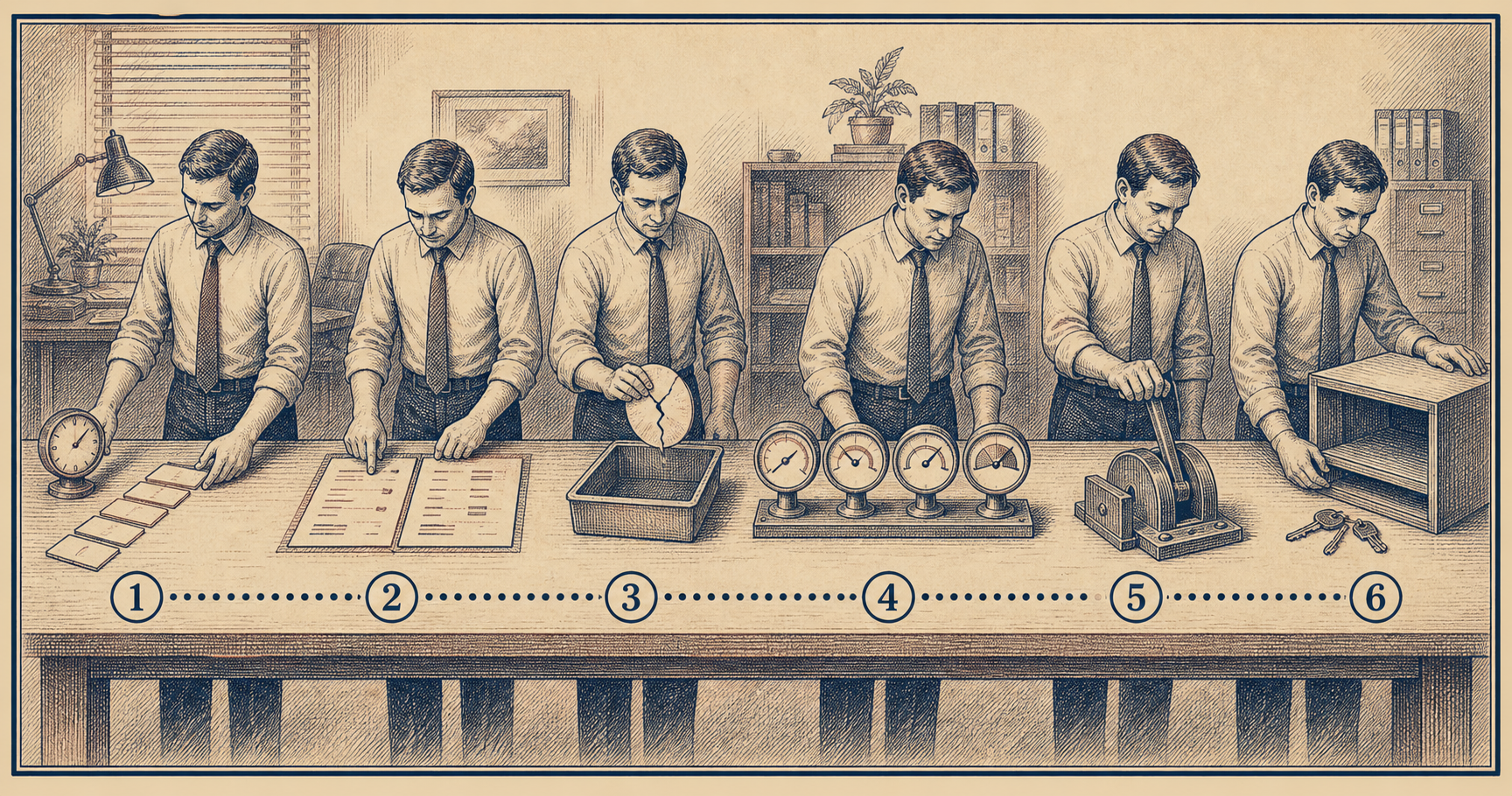
That last distinction matters. This article uses one small cost example to make the idea visible. It does not claim that the example proved every capability in production.
How to move from a local rehearsal to live action
Do not jump from a useful model to broad authority. Move one step at a time.
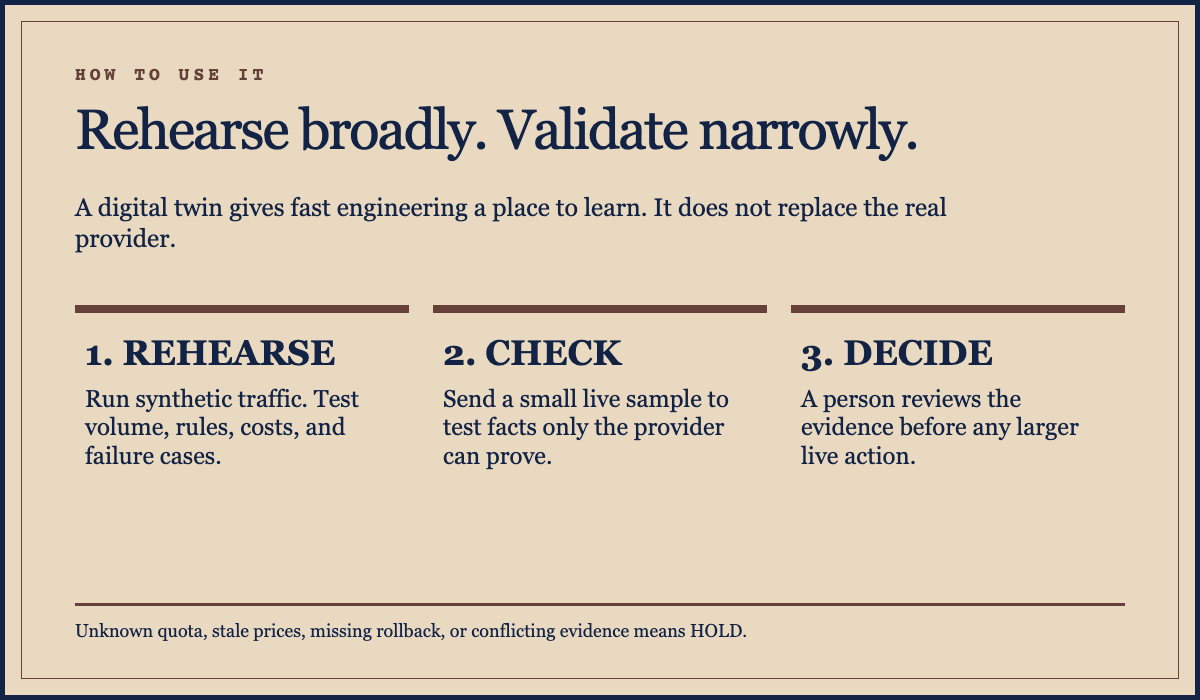
- Rehearse: use synthetic events to test volume, rules, costs, and failure cases.
- Check: send a small live sample to test facts that only the provider can prove.
- Decide: have a person review the result before approving larger live traffic.
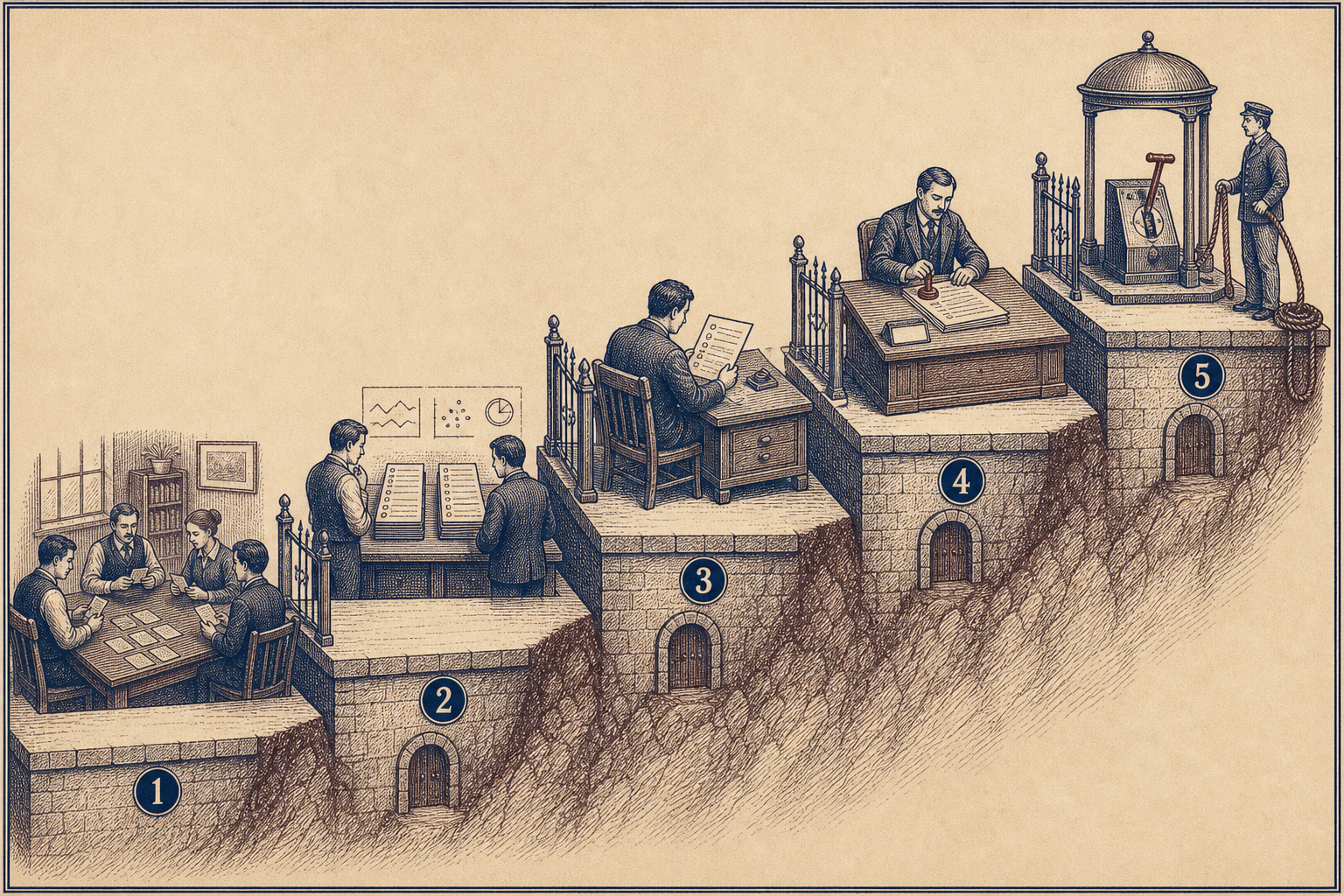
This progression does not grant autonomy. It creates a way to earn limited authority with evidence. Automated quality checks still need human control, especially when a failed action can affect a partner or create a bill.
Questions to answer before building one
Start with the decision, not the technology label.
- What real service or process are we copying?
- Which decision should the copy improve?
- What evidence keeps it current?
- How will we compare its forecast with what really happened?
- What is it forbidden to do?
- Who approves a live action?
- How do we undo that action?
- How do we remove its access when the project ends?

If those answers are missing, the next step is not a bigger platform. It is a clearer decision boundary.
Three quick questions
What is a digital twin?
A digital twin is a working copy of a real thing or process. It helps a team see changes, replay events, and test a choice before acting on the real system. NIST describes digital twins as electronic representations of real-world entities and their state changes.
Does this example call Google Maps?
No. The rehearsal environment never called the official Google API. It used synthetic events inside the digital twin, then applied Google's published pricing to a possible live run.
Does a digital twin replace live testing?
No. It moves broad exploration away from the live provider. A small live check is still needed for facts that only the provider can prove, such as current quota behavior and account-specific billing.
Build the capability before the factory
A software factory needs more than fast code generation. It needs a way to learn from changes without forcing every question through a live system.
That is where the digital twin belongs. It gives the team a working copy for broad exploration. It gives leaders a cost view before the bill arrives. It gives the organization a place to record what is known, what is assumed, and what is still unknown.
That connects to the wider software-factory argument in the case for readying repositories before building a software factory and to the stronger authority question raised by the dark-factory discussion. Automation is not the finish line. A governable learning loop is.
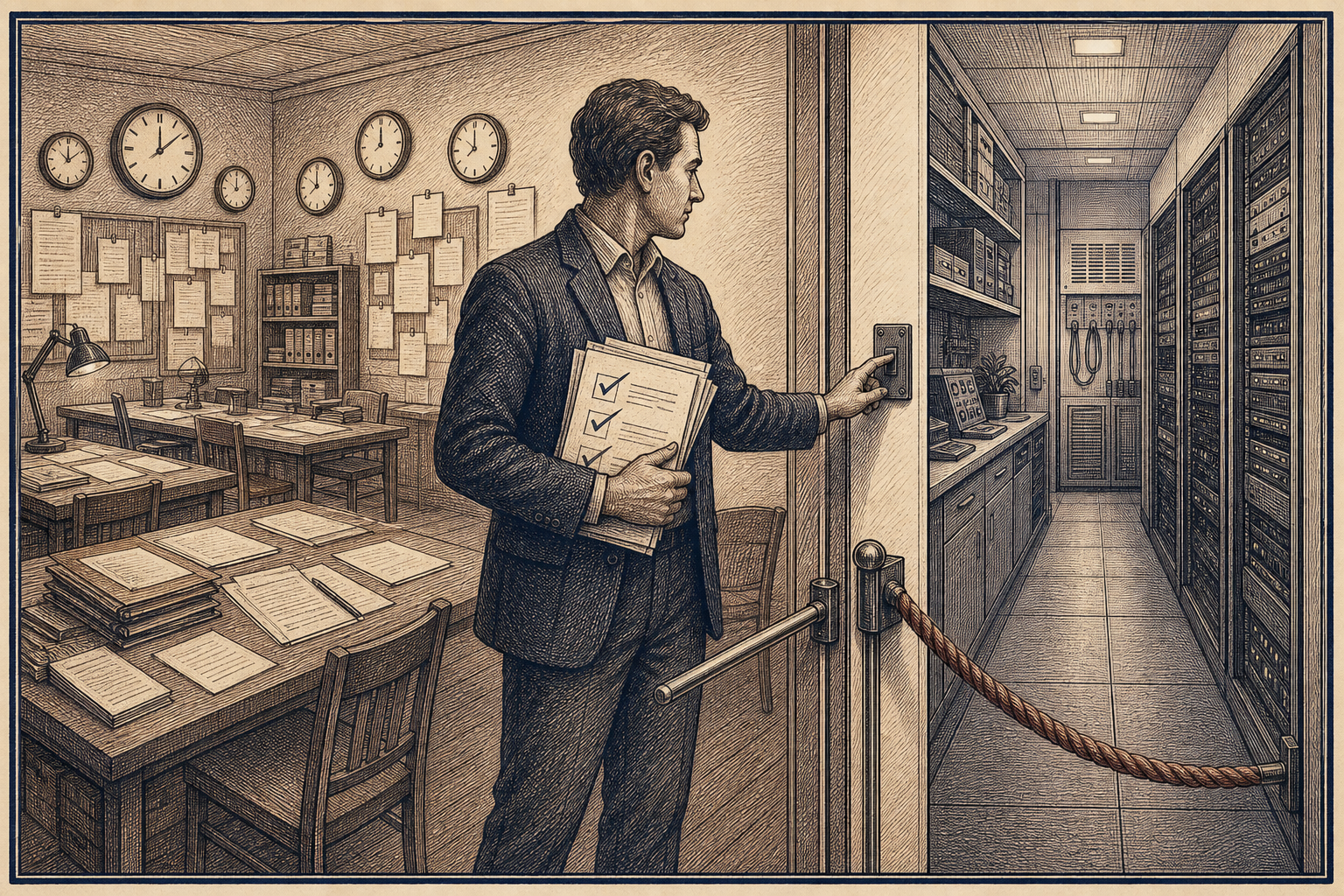
Before approving the next paid-API test, ask the team to show four things on one page: the synthetic event count, the billable-event assumption, the current live quota, and the human stop rule.
Then decide what deserves a live call.
That is the practical promise of digital twin engineering: learn without leaning on the partner, measure before scaling, and keep the boundary visible when software moves from rehearsal into the real world.