
Your Job, Rewritten

Your job title may survive AI longer than your job description.
The change could arrive as a reasonable request: build the prototype yourself. Explore the customer data before asking an analyst. Have an agent prepare the first review, then bring your judgment to the result. Each request moves a little more of a project into one person's hands. Eventually, the team has to reconsider whom it needs, what it expects them to know, and which work still gives a newcomer a way in.
The companies building AI are already confronting parts of that future. Their employees have unusually powerful tools close at hand, and their internal experience gives the rest of us something more useful than another prediction about jobs: a view of organizations trying to accommodate people who can suddenly do more.
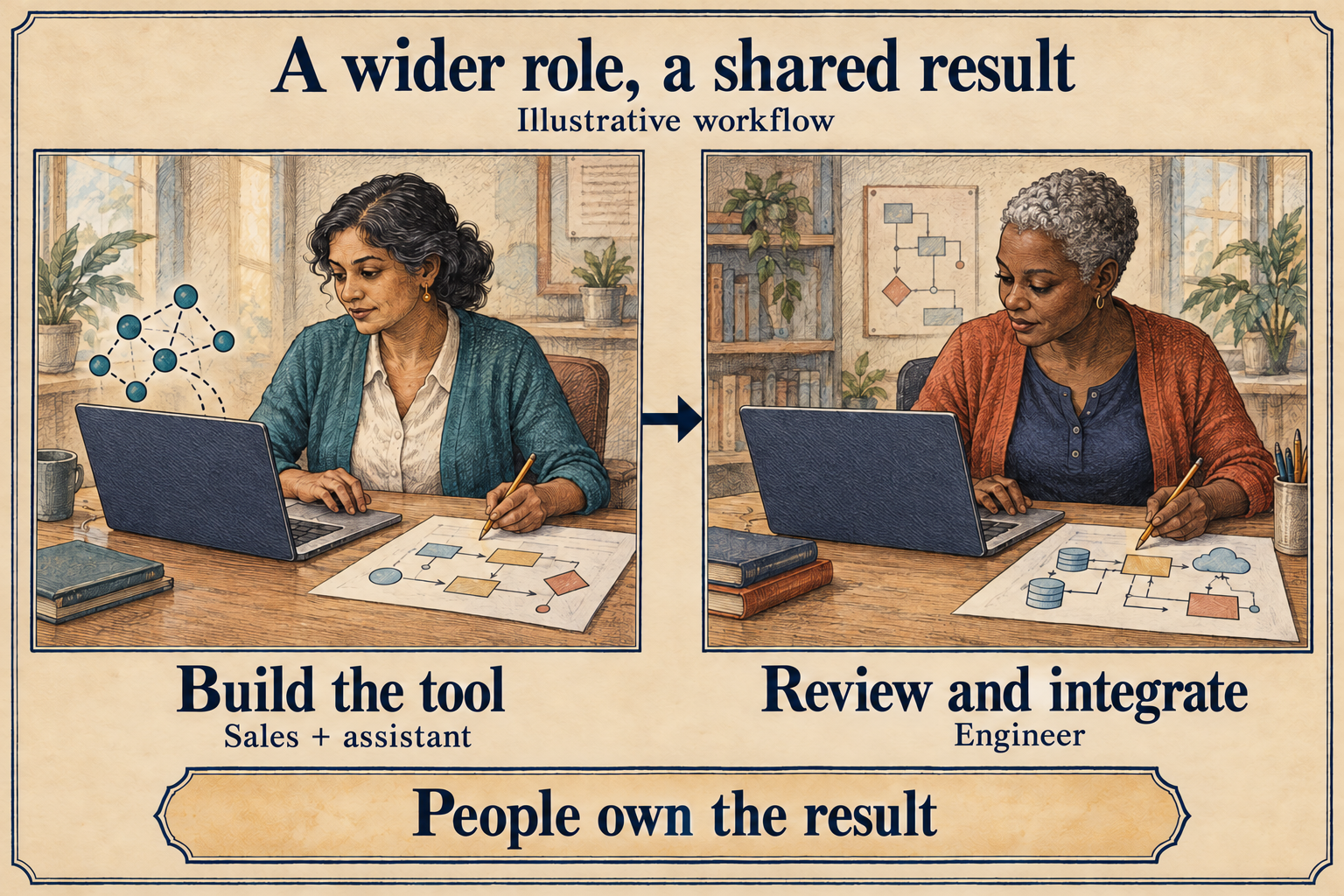
At Anthropic, a sales representative built a custom dashboard and pipeline in three to four hours. The interface and connections between tools had been outside their wheelhouse. An assistant made it possible to start solving the problem inside sales.
For anyone who has waited on another team's backlog, the appeal is obvious. The sales rep can show what they need through something that works. An engineer can inspect it, improve it and identify the problems its creator missed. A familiar handoff has changed, and that leaves the employer with a decision about where the specialist belongs next.
More of the job lands with you
This is happening well beyond software engineering. Anthropic describes a financial manager building an agent to review purchase requests, a lawyer automating initial risk and copy review, and a recruiter using assistance for sourcing, tracking applications and analysis. OpenAI describes coding agents spreading into its legal, finance and recruiting teams for automation, data transformation and structured analysis.
The important capability is combining professional context with execution. Someone who understands the business problem can carry it further before calling on another specialty. Among 885 product managers at Microsoft, 12% reported using generative AI to prototype ideas or write code.
A product manager with a working prototype gives an engineer a different conversation. They can test an idea, examine its behavior and discuss what a dependable version would require. The product manager has gained reach. The engineer still brings knowledge that a convincing demonstration may conceal the need for.
That combination helps explain why broader roles do not make expertise irrelevant. More people can produce plausible work; someone must still recognize the mistake that matters. At OpenAI, code and experiment production accelerated alongside growing compute resources, while people continued to choose which questions and results deserved attention. At Anthropic, employees are building instructions and monitoring tools to manage agents. At these companies, expanding output has brought work on defining, evaluating and coordinating the result.
For an employer, the temptation is to reorganize around that broader capability. Microsoft's proposed Work Charts describe teams of people and agents assembled around outcomes. Our earlier research on full-stack builders points in a similar direction: fewer handoffs between professions, with specialists available where their depth matters. These are organizational designs to test, rather than a reason to assume every employee can become every kind of expert.
The consequences reach beyond an individual's productivity. When one person can carry more of a project, management has more ways to assemble the next team.
A growing company can change who it needs
Anthropic tripled in size over the prior year while technical departments fell from 61% to 56% of its workforce. Technical hiring continued to grow; sales, finance and recruiting grew faster.
Imagine looking only at the company's total headcount. You would see rapid expansion and miss the shift in its composition. Looking only at the technical share would create the opposite mistake: a smaller percentage does not tell you that technical employment fell.
Inside the organization, different functions were responding differently. Managers contributed more code. Administrative automation and outside ticket-service support helped the company absorb growth without a matching expansion of clerical functions. AI was part of that change, alongside business growth, outsourcing and management choices.
This is the workforce question that a simple count of jobs obscures. How many people are needed for a given amount of useful work? How many people does the business actually employ? Where do they sit across functions and experience levels?
Those answers can move in different directions.
Consider a customer-support team of ten people resolving 1,000 issues a week. A study of 5,172 support agents found a 15% average increase in issues resolved per hour with AI assistance. If that improvement carried over to our illustrative team, it could resolve 1,150 issues in the same hours.
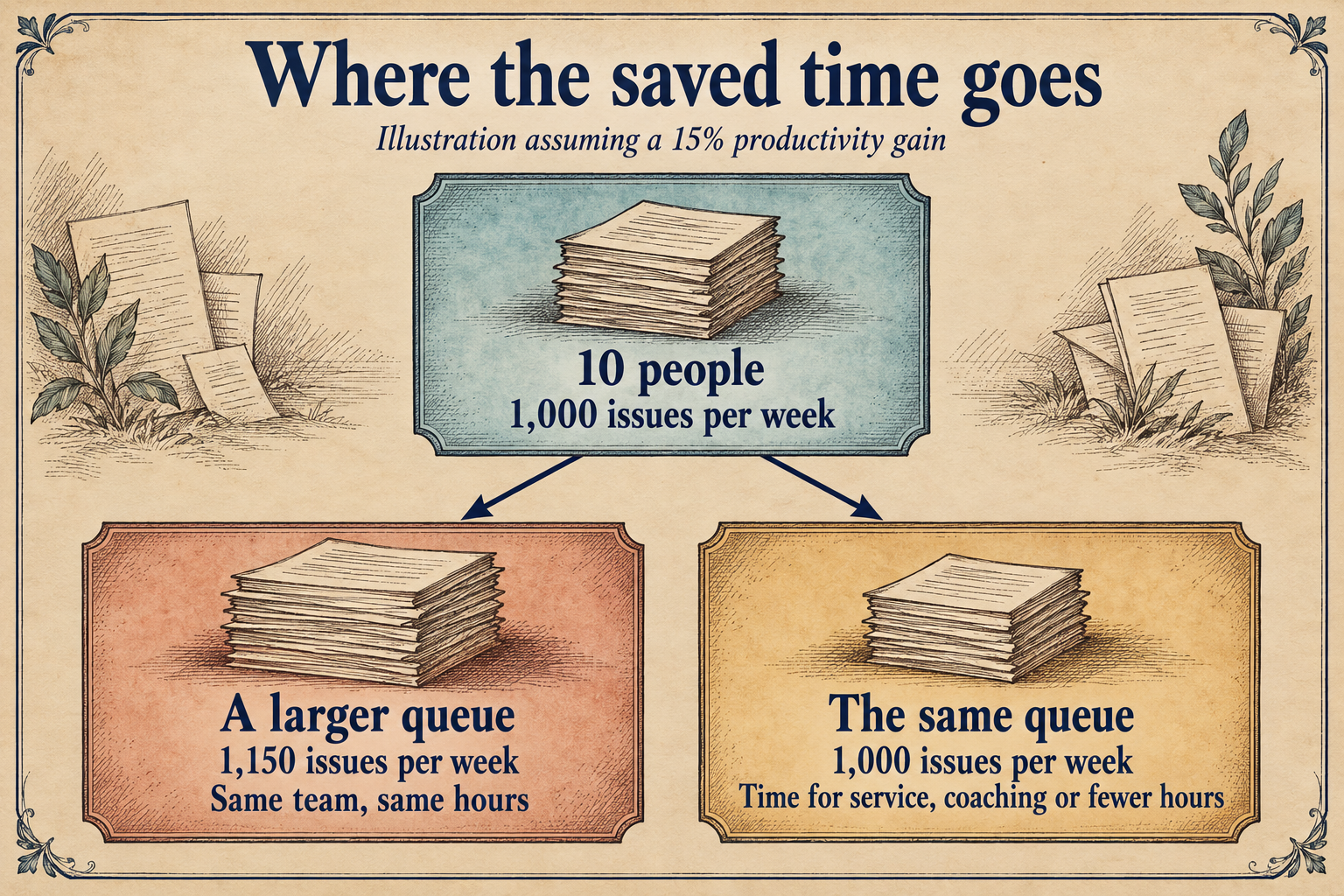
If customers need the extra help, the team has room to serve them. If demand remains at 1,000 issues, management has time available for harder cases, better service, coaching, shorter hours or a staffing reduction. The productivity gain does not select among those choices. Customers, budgets and leadership do.
That is why the frontier labs are valuable early examples without being representative employers. Their fast-growing businesses can absorb capabilities that a company with weak demand might use to cut costs. We can learn from their bottlenecks without assuming that the rest of the economy will reproduce their hiring patterns.
OpenAI's internal accounts help explain changing work and review demands. Anthropic adds unusually useful information about the makeup of its workforce. The OpenAI publications examined here do not supply an equivalent company-wide hiring breakdown. That leaves an important part of the comparison unanswered, rather than giving us permission to translate agent activity into missing human jobs.
Opportunity can disappear before jobs do
An employer does not have to announce layoffs for someone outside it to feel the change.
A freelance assignment may never be commissioned. A vacancy may remain unfilled. A growing department may direct more of its hiring toward people who can work independently across a wider range of tasks. For the person trying to enter, the obstacle is real even while the business expands.
There is evidence of this uneven pressure. On one freelance platform, writing and coding postings fell 21% relative to jobs the researchers classified as manual-intensive during the eight months after ChatGPT's release. That comparison group included data and office management, audio and video services. Stanford's payroll research also found employment among 22-to-25-year-olds in more AI-exposed occupations falling behind same-age workers in less-exposed occupations from November 2022 through June 2026, primarily through weaker hiring. Education differences and earlier trends complicate how much of that gap can be attributed to AI.
The broader picture is mixed. A Danish study covering eleven exposed occupations through December 2024 found no detectable adoption-linked change in earnings or workplace headcount. Its early observation window cannot tell us what newer agents will do. Taken together, these studies show pressure in particular markets and entry routes, not an established economy-wide contraction in demand for human labor. Much of this evidence concerns knowledge work, leaving substantial questions about care, physical services and other occupations.
For a worker, the practical implication is to look beyond whether the employer is growing. Which work is it buying less of? Which functions are expanding? What does it now expect an experienced person to handle?
The last question leads to the hardest problem in this emerging workplace.
Everyone wants experience. Someone has to produce it.
Since early 2025, the junior share of Anthropic's technical hires fell from 27% to 9%. Juniors also fell from 21% to 14% of its technical staff. These are shares, and the company does not provide the absolute junior-hiring counts. They nevertheless show an expanding employer directing more of its hiring effort toward experience. Hiring managers increasingly emphasized autonomy and judgment.
That preference is understandable when a person is expected to direct agents, recognize their mistakes and take responsibility for a larger result. It creates an uncomfortable question for everyone else: where will they get the experience that qualifies them for that job?
The routine assignment often does two things. It produces something useful and lets a beginner practice. A junior developer traces a failure. A new lawyer learns why an ordinary clause matters in context. A support worker discovers when the standard answer is wrong for this customer. Moving those assignments to agents also changes the opportunities to learn from them.
Output and understanding need separate checks. In an Anthropic experiment with 52 mostly junior developers, the assisted group averaged 50% on an immediate understanding quiz, compared with 67% for those who completed the unfamiliar coding task by hand. Debugging showed the largest gap. That is a short-term result, not a forecast of anyone's career, but it gives employers a concrete reason to check what people understand beyond the answer they submit.
LinkedIn's announced two-year rotational Associate Product Builder Program offers one proposed way into a broader role. Its ability to develop independent practitioners remains to be demonstrated. Anthropic's discussion of internal redeployment addresses existing employees; it does not resolve how newcomers enter. The accounts examined here do not establish a proven replacement for the junior-to-senior pathway.
Every employer can try to hire people trained elsewhere. If too few make room for beginners, they undermine the supply of expertise they all want to buy. Developing people has to become an explicit part of the staffing plan: meaningful paid assignments, time for coaching, and opportunities to explain and repair assisted work with progressively less help.
The team is a choice
Groktopus's work on earned autonomy asks what an agent should be allowed to do, with what evidence and oversight. The workforce question sits beside it: what should people be responsible for, and how will they become capable of that responsibility?
A sales rep may build a dashboard while the assistant remains limited to drafting an internal recommendation. Updating live customer records requires a separate permission decision. Broader human roles can coexist with narrow, revocable machine authority. Neither tells management how many people to employ.
That is where our commitment to fewer silos matters. An employer can use broader capability to serve more customers and give people more ownership. It can also use it to consolidate assignments and concentrate opportunity among experienced workers. Demand constrains those decisions, but it does not remove the responsibility for making them.
The companies inventing AI are giving us an early view of those choices. The most useful lesson is to watch how work, responsibility and opportunity move together. Your title may stay the same while your remit expands, the colleagues around you change, and the next applicant faces a different threshold for entry.
That is the team we need to prepare for, and the team employers are already beginning to build.