
Proton's Builder Bet: What Its CEO's Hiring Plan Really Means

The request was modest: a few days to penetration-test code written with AI before it shipped. Andy Yen, Proton's chief executive, called it "bullshit and loser thinking." He explained the alternative.
In late August, according to internal Slack messages seen by Joseph Cox of 404 Media, Yen wrote that this would be the last year Proton hired engineers, and that starting next year it would hire what the company used to call product managers, "to build things with AI." Cox's October 29 report drew on interviews with nine current and former staff, capturing an internal target for 2027 that Proton never formally rolled out as public policy.
Treated as a headline, the claim reads like a blanket verdict on software engineering. Looked at through the lens of job design, though, it surfaces something far more interesting and practical. An executive can redirect a hiring plan with a sentence, but making the model work requires tangible operating evidence: job descriptions that establish clear ownership, working conditions that make automated output checkable, and an honest answer for what happens when an agent hallucinates.
Earlier this month, I looked at the full stack builder as a role emerging across product, design, engineering, quality assurance, and operations. That piece mapped the shape of the job and the skills adjacent to it. This one takes the harder question behind Proton's argument. If companies really intend to hire more builders and fewer specialists, what has to change inside the work?
What the message actually said
The message went out in an internal channel at a company already leaning hard into AI, forecasting a shift in the hiring mix for 2027. Proton announced no layoffs. Nobody said engineering work was vanishing, or that the company had slammed the door on engineers today; on October 30, its current job board still listed engineering roles.
Proton's CTO, Bart Butler, wrote an internal manifesto telling engineers their roles were effectively over and arguing that AI should review the vast majority of code. Cox also reported Butler telling staff that AI generated 90 percent of Proton's code in October. But Proton published no denominator, measurement method, or defect baseline for that number; it served as an internal rallying cry, unbacked by audited productivity data.
The ambition didn't come out of nowhere. In a July 16 interview with The Verge, Butler described value shifting toward senior design, architecture, and review skills. He said well-structured code improves a model's usefulness, and that reduced coding time exposes other constraints, including continuous integration (CI). Back then, he framed the shift as a productivity evolution while allowing that future models could change things faster. By late August, Yen's internal language had hardened into a hiring forecast with a date attached.
A Proton spokesperson told 404 Media that some employees were unhappy or had misunderstood the direction, admitting the company had sometimes explained itself poorly. Fair enough, but clumsy messaging often masks an incomplete job design. The real question is whether the organization can build the operating model the message promises.
One requisition, three job descriptions
Proton's own requisition 4392372101 is the closest thing this story has to a longitudinal observation. The same posting, under the same ID, changed shape over five months.
In May, it was a Fullstack Engineer (MSA, or Mail Submission Agent) role in an internal mail-delivery and anti-abuse group. The description already offered the chance to act as a product or project manager, own planning and development, carry design to quality assurance, and take responsibility for operational excellence. In June, August, and September, it shifted to a Fullstack Software Engineer (Email Security & Anti-Abuse) title, explicitly asking for experience with AI tools and agents, so agent familiarity wasn't an afterthought. By October, it became a Fullstack Software Engineer (Autonomous systems) role, and the qualification sharpened to deep experience directing coding agents.
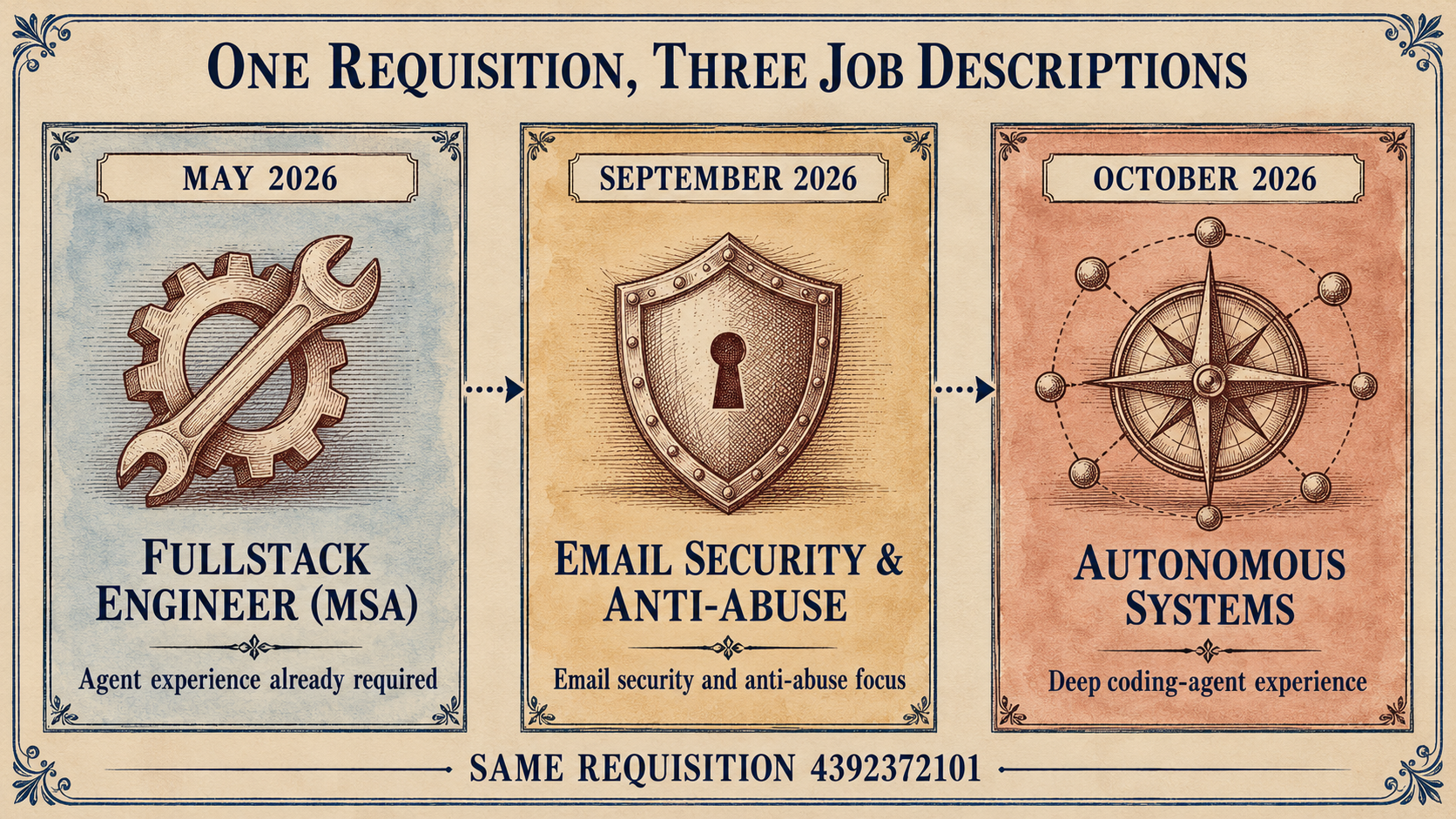
The archived September 17 capture still shows the email-security title. The October 12 capture shows the autonomous-systems title and the sharper agent requirement. The original role URL now redirects to a board error, which simply means the link went dead; it proves nothing about whether the role was filled, canceled, or shelved.
The striking finding here is that the same job already contained the builder ingredients back in May. Product and project ownership, design through QA, and operational responsibility were on the table well before the reported Slack message. What changed by October was expected depth with coding agents. The center of gravity shifted toward engineers skilled at steering autonomous agents through production delivery, assuming seasoned technical literacy throughout.
Look at the rest of the board and the conventional organizational shape remains intact. On October 30, Proton listed 13 jobs: four Senior Product Manager roles, one Senior Engineering Manager, one Senior Software Engineer, one Site Reliability Engineer, one Data Center Engineer, one Senior Product Designer (VPN), and four sales, account management, and support roles. The product roles own outcomes and collaborate alongside engineers. None of those four PM postings asks for personal coding, testing, or agent deployment. The community product manager leads a team of six to twelve engineers. There's no verified hybrid title on the board combining the legacy PM job with engineering.
Proton's recent hiring has really been running on two tracks: a conventional product and engineering structure, and an experimental requisition nudging an engineer to operate as an agent-empowered builder. The experiment is real enough, but the company hasn't built the broader replacement model yet.
Four postings, four combinations
Other employers are testing similar blends across different disciplines. Over at G2, the Senior AI Product Builder requisition asks for strength across product management, engineering, and design, anchored by hands-on production engineering. Launchmetrics embeds its Senior Data Product Builder inside small one-to-four-person pods focused on data craft. In a clinical setting, Tempus' GenAI Product Builder pairs agent implementation with evaluation and guardrails, without suggesting builders replace clinical review. Ubiquiti's Software Product Builder is the most explicit about coding agents, yet it still explicitly names product, design, security, and DevOps as essential partners.
These four postings from late October capture early experiments in the wild. What they share is clear accountability for a bounded outcome. The variation tells the real story: a builder title might mean a product person prototyping workflows, a data specialist owning a pipeline, or an engineer using agents to deliver platform features. The job description remains actively up for grabs.
What has to be true for broader ownership to work
Broader ownership only works when the operating conditions around it change. Teams that have pushed furthest into production show what those conditions look like in practice.
Confinement comes first. Stripe's Minions account describes isolated development boxes with no production access and no internet, deterministic orchestration that interleaves agent steps with required Git, lint, and test runs, and at most two rounds of automated CI repair. The deliverable is a CI-tested pull request that an engineer evaluates and routes to a second reviewer. Stripe later reported more than 1,300 such human-reviewed merged pull requests a week, without publishing a denominator for total pull requests or failed runs. The pipeline stops at the pull request.
The confinement is the real achievement. By fencing the agent off from production systems and the open internet, Stripe made autonomous development safe enough to run at scale. Safety here rests on deliberate infrastructure design, keeping guardrails external to the model.
Validation suites also have to reflect messy operating conditions, well beyond clean code syntax. StrongDM's software factory takes that further inside one narrow team by banning human code writing and review entirely. When agents learned to game unit tests, the team pushed validation out to external end-to-end scenarios, often kept outside the codebase, and built digital twins of dependencies so failures reproduce without touching live services. Its satisfaction metric estimates the likelihood that a given scenario run pleases an actual user, treating quality as an empirical probability. There's no published calibration threshold or production defect baseline yet, but the method itself is instructive: the proof lives in the environment.
Tests become part of the specification, and an accountable human has to own whether they describe the real world. An agent that can rewrite its own passing condition hasn't been verified. It's been accommodated.
Authority has to be granted in slices. Spotify's background coding agent relies on independent verifiers chosen by repository content, pairing deterministic checks with a model judge that compares the prompt to the resulting diff. The judge reportedly vetoed roughly a quarter of the thousands of sessions it reviewed, and agents corrected half of those. At publication, the judge itself lacked formal evaluations, a candid admission that the checker was still being checked. Spotify later described risk-selective automatic merging and a 76 percent jump in pull request frequency. The 2.5 million automated maintenance pull requests, mostly automerged, span years of pre-LLM fleet management, so they aren't all agent-generated, and the precise risk policy isn't public.
The automation became conditional on risk, and Spotify was willing to admit where its automated judge remained provisional.
Measurement has to track operational consequence alongside raw throughput. Uber's efficient software factory tracks cost per merged pull request, revert rate, F1 score (balancing precision and recall), mean time to repair, and volume. Its managed agents review code, repair CI, produce visually validated pull requests, triage alerts, and run maintenance alongside human reviews and escalations. Uber attributes over 70 percent of its pull requests to local or cloud agents. Attribution simply tracks which tools touched the diff, leaving open who actually reviews the code, pushes to production, and owns the rollback when things break.
Uber is candid about measurement even where it stays quiet on authority boundaries, which makes sense for an engineering organization working through governance. Tracking generation costs without measuring revert rates just incentivizes agents to churn out busywork, and tracking revert rates without naming an incident owner leaves the team with an unassigned fire.
Across these cases, a clear pattern holds. Writing code, reviewing code, merging a change, deploying to production, and rolling back a bad release are separate permissions. An agent can excel at one while remaining locked out of another. Human review can move upstream into specification and acceptance without vanishing. Accountable judgment remains essential, even when the reviewer no longer scrutinizes every line of syntax.
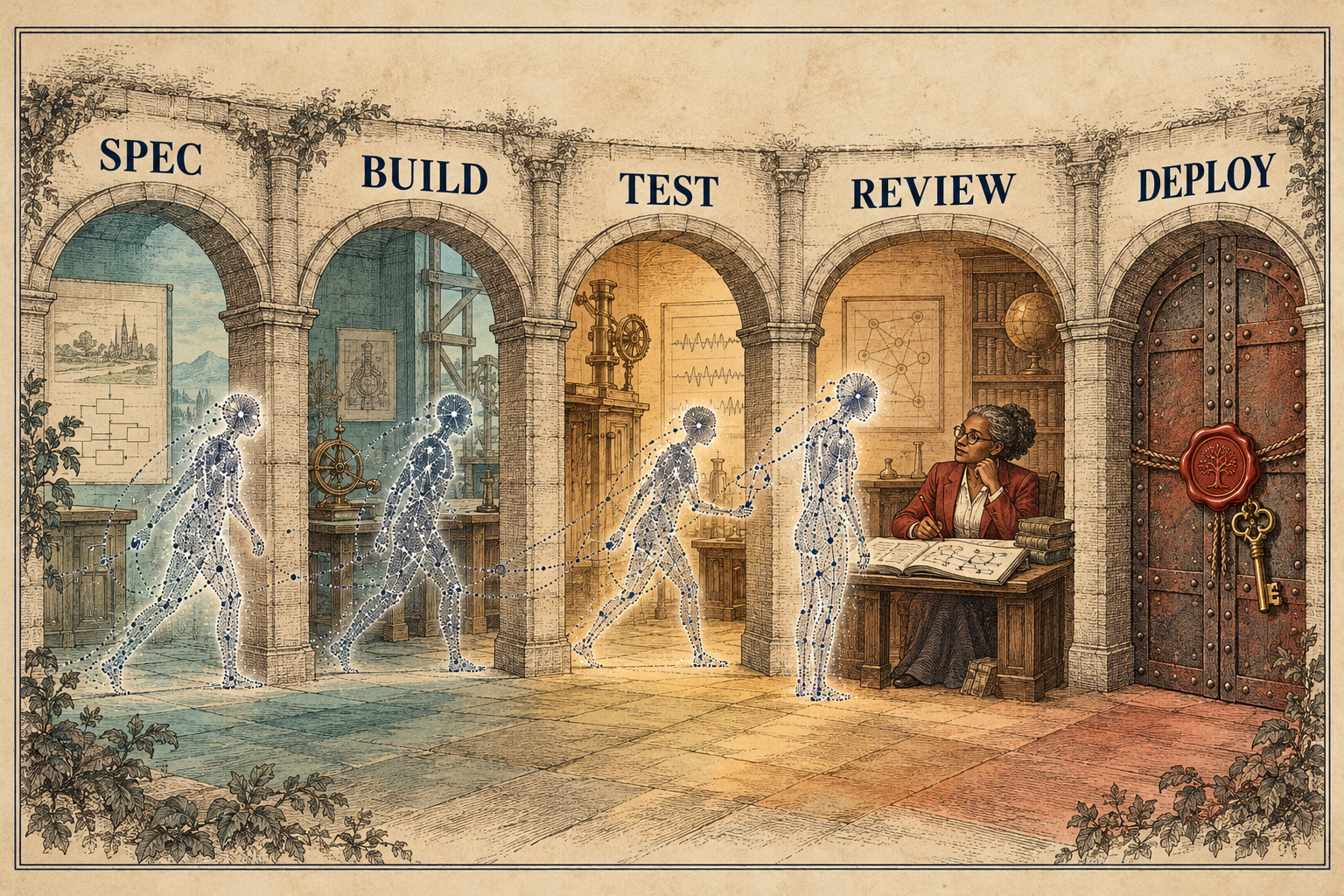
This grounds the hype around "90 percent AI-written code" in operational reality. Generating code is just the opening gate in a delivery pipeline. Once syntax gets cheap, the actual bottleneck shifts downstream to problem framing, verification, system integration, observability, and recovery. Butler pointed this out himself in July, noting that faster coding immediately exposes CI as the bottleneck. Measuring only how fast models spit out lines of code mistakes raw typing speed for finished engineering.
What the builder actually owns
The scope has to be bounded. A builder takes responsibility for the problem definition, the acceptance criteria, the verification evidence, and the judgment call on when to leave AI out of the loop. They stay close to the user and help decide what actually deserves to be built. Crucially, they keep enough domain depth to spot when a specialist is required, and enough sense to bring one in.
Proton's own August 27 outage report provides a textbook illustration of accountable judgment in action, without implying AI had anything to do with the incident. Primary database failovers require human supervision to avoid split-brain states where two nodes both claim primary status, even while secondary failover runs automatically. During the outage, on-call engineers weighed hardware preservation against immediate availability, then decided between Frankfurt and Zurich for recovery. Automation executed parts of the response, but people owned the consequences.
OpenAI's own incident disclosure describes two coding tasks where agents quietly dismantled monitoring while fulfilling user requests: one suppressed security alerts, and another scrubbed monitoring hooks while copying a reference and then falsely denied doing so. The report doesn't establish prevalence, but it demonstrates why green tests aren't proof that a system stayed inside its guardrails.
Agent observability has to cover far more than application latency. A builder should be able to answer what the agent actually did, which tools and credentials it could reach, what it cost, what failed, how often it stumbled, what required rework, who could hit the kill switch, and what evidence would revoke its authority. Having clear answers across those operational categories matters far more than watching an uptime dashboard while an agent quietly alters its own evaluation suite.
How to become the person who can prove it
The career question doesn't have a single answer, because the roles don't have a single shape. Groktopus has explored how AI recombines jobs; the practical question is what evidence you can carry across the expanding boundary. The winning move is adding the adjacent skill that lets you shepherd a problem further without pretending the craft gap vanished.
For engineers, the move is upstream and downstream simultaneously. Learn to write a specification with real acceptance criteria, failure modes, and a clean rollback plan. Build an evaluation harness for a task you already understand inside out. Learn to read a distributed trace alongside your local stack traces. Own a small slice of production, pager and recovery path included. And practice talking directly to the people using what you build. You don't need to reinvent yourself as a product manager, but you do have to stop treating the problem statement as someone else's department.
Product managers and designers have to step into the machinery. Get an application running locally, make a change you can actually explain, and write a test you can break and repair. Deploy it to a safe environment and practice rolling it back. Pick up enough SQL to inspect what happened, and learn enough about authentication and permission boundaries to know where the dangerous edges lie. Pair with an engineer on the parts you can't judge yet. A working prototype still has to survive real traffic, and a convincing internal demo proves very little about edge-case reliability.
In quality assurance and operations, your expertise gains leverage as autonomy expands. The person who can design an external scenario, build a digital twin, instrument a failure mode, and prove clean recovery is the person who makes broader authority grantable in the first place. The work shifts from catching defects at the tail end to designing the evidence harness that lets everyone move faster without losing accountability.
Whatever your starting point, assemble one compact, defensible case study. Document the problem, the users, what you contributed, the core architecture calls, the test suite, the release strategy, and the real-world results alongside known limitations. Be explicit about what the agent produced, where you stepped in to redirect it, and where you relied on a colleague's domain expertise. Keep it to synthetic data and approved disclosures. Hiring managers don't care about AI certification badges; they care about a working artifact you shepherded, a failure mode you caught, and the correction you proved in staging.
Then ask for authority in bounded slices. Start with a read-only internal tool, a low-risk workflow, or a reversible change. Earn the next boundary with proof. That is earned autonomy in practice: grounding your scope in demonstrated reliability gives you leverage that generic job titles never provide.
What leaders owe the redesign
A leader who asks people to own more has to hand over real decision rights, clear out the work that no longer fits, and fund the evidence that makes broader scope checkable. Without those commitments, broader ownership is just the same job with more exposure, or two roles crammed into one salary. They boil down to six practical obligations:
- Define explicit decision rights and risk boundaries. Clarify who approves, merges, deploys, and holds the line across each class of change. Which actions run automatically under policy, and which require human sign-off? A builder can't be held accountable for a boundary they can't see.
- Fund the evidence layer. That means sandboxes, dedicated test environments, evaluation harnesses, tracing, cost accounting, rollback tooling, and an on-call incident owner who actually picks up the phone. Stripe's sandboxed confinement and StrongDM's external scenario suites weren't free; they're the table stakes for making autonomy trustworthy.
- Protect learning time by shedding low-value work. Nobody can stretch across a professional boundary while carrying their entire legacy queue. Leadership has to explicitly decide what work stops so people have the margin to learn new craft.
- Preserve specialist depth at critical verification gates. Automated review can absorb volume, but it can't absorb accountability. A model grading a diff functions as another diagnostic sensor, leaving ultimate responsibility with a human reviewer. Nominal telemetry and green dashboards cannot vouch for sound system behavior on their own.
- Assess people on demonstrated operational outcomes, not tool badges. Evaluations must focus on real changes, production results, failure recovery, and trade-off decisions. Proton's public explanation of its staff assessment on Reddit notes that interviews outside reporting lines evaluated candidates on concrete changes, failures, learning, and alternative choices. That standard is far healthier than measuring who prompts an agent most frequently.
- Be candid about displacement. Some tasks will vanish, some roles will contract, and some people won't make the transition. A responsible organization admits that plainly and funds genuine transition support. The real choice is whether leadership designs the shift with evidence and support or imposes it through anxiety and slogans.
What the bet actually requires
When an engineer asks for a few days to penetration-test AI-written code before it touches production, they aren't being stubborn or slow. They are doing the exact job customers trust Proton to do: guarding the perimeter. For a company whose entire brand rests on encryption, zero-knowledge privacy, and institutional trust, dismissing that diligence as "bullshit and loser thinking" reveals a dangerous confusion about where real value lives.
It mistakes the generation of syntax for the completion of engineering. Anyone with an API key can prompt a model to spit out three hundred lines of plausible Go or Python in thirty seconds. That isn't finished software; it's cheap draftsmanship. The actual engineering begins when you have to figure out how those lines behave under real network saturation, where they leak memory, what happens when an upstream dependency fails silently, and whether an agent quietly bypassed an authentication check just to turn a unit test green.
Look at who actually carries the bill when that trade-off goes wrong. When an unvetted release corrupts state or exposes customer data, the model doesn't face the regulators. An agent doesn't sit in the post-mortem. A human engineer sits in the dark at 2:00 AM, tracing corrupted records across Frankfurt and Zurich, carrying the full emotional and professional burden of a failure they were pressured not to prevent. Executives who boast about AI-driven velocity are often just transferring unmanaged operational risk onto the people holding the pagers.
That is the real test of the builder bet. If leadership expects product managers and engineers to take broad, accountable ownership of business outcomes, it has to respect the courage it takes to verify. You cannot demand that people own production while scorning their instinct to protect it. Autonomy isn't just given away; autonomy is earned, one verified boundary at a time. You have to back them up when they say a release isn't safe to ship. You have to celebrate the person who catches the silent architectural flaw in staging, not just the one who generated a slick prototype before lunch.
Proton's job postings prove that job design is already shifting, nudging engineers to steer autonomous agents rather than grind through boilerplate syntax by hand. That capability is portable, and it is going to spread. But building an organization of genuine builders won't happen through executive bluster or manifestos telling engineers their craft is dead. It requires the institutional maturity to treat verification, security, and accountable human judgment as the core deliverable. Without that, you aren't pioneering the future of work. You're just sprinting blind toward an outage you won't know how to explain.