
Jev and Laya Put Probability Where Enterprise Workflows Need It

For three years, enterprise engineering has been trying to force conversational models into software pipelines that never wanted a conversation.
We didn't want an agent to invent the workflow from scratch. We wanted our battle-tested, deterministic state machines, with a few probabilistic decisions sprinkled in where messy reality breaks our boolean rules. Until recently, you had two bad options if you wanted that: spend millions hiring a specialized machine learning team to train and maintain bespoke classifier models, or jam a general-purpose LLM into an API call, wrap it in prayer and Pydantic schemas, and eat the latency and cost.
That compromise is finally breaking. Jev and Laya represent the arrival of general-purpose, off-the-shelf decision models: systems designed not to generate text, but to evaluate state and return typed probabilities. The tool enterprise architects were actually reaching for is finally here, and the party is just getting started.
Enterprise systems need control, not conversation
A support queue routes a straightforward password reset with a five-line rule. The problem begins when a customer writes three paragraphs mixing a complaint about billing with hints of an account takeover, skipping the one detail your router actually looks for. A general LLM can read between the lines. It can also respond with a thoughtful essay when the database only wants a categorical enum.
Engineers have spent years taping over this mismatch. You prompt for a label, demand JSON, write a parser, retry when the grammar blows up, validate fields, add guardrails, and dump ambiguous failures onto a human queue. OpenAI laid out this exact treadmill of prompt tricks and retries when it introduced Structured Outputs. Provider-level strict schemas fixed most of the syntax failures. They did nothing for bad reasoning, refusals, timeouts, or policy enforcement.
Can a model make a single bounded estimate while deterministic code retains control over what actually happens?
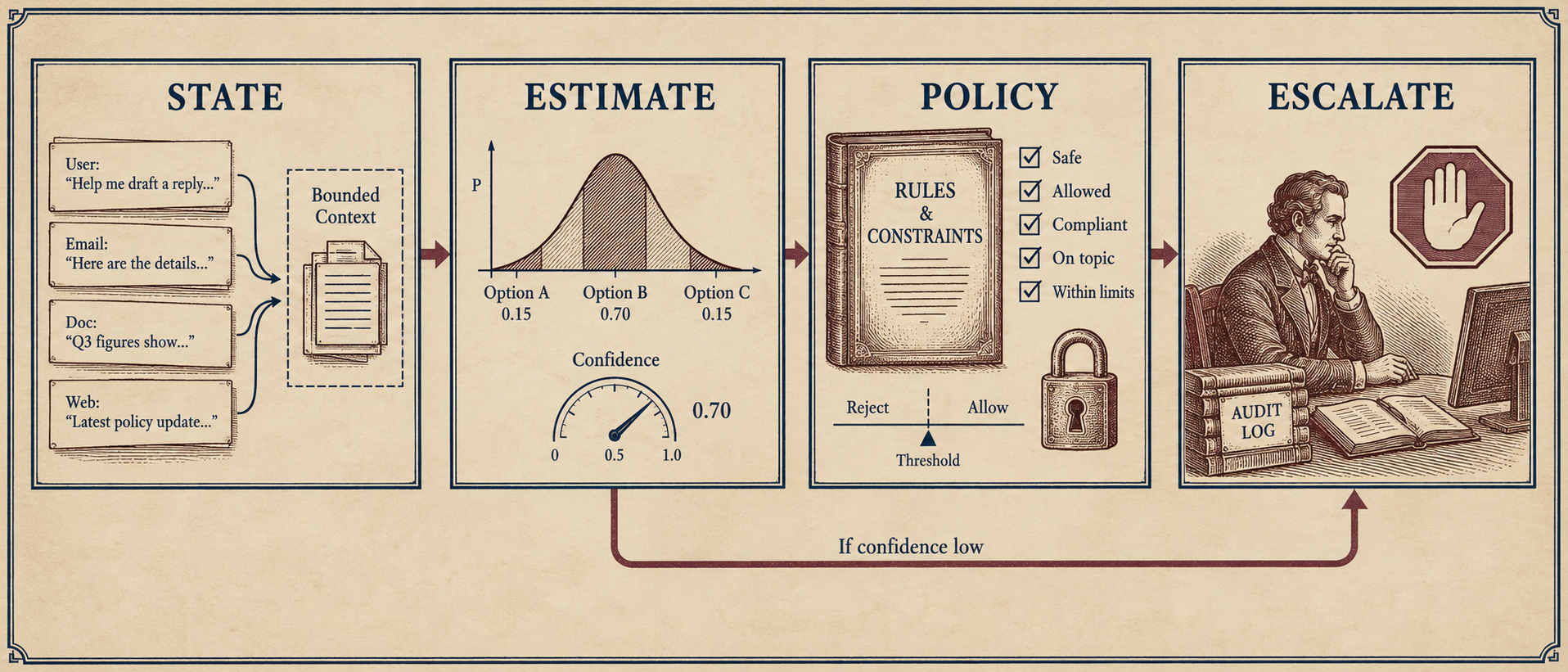
That is the actual role for a typed decision model. The model estimates intent, urgency, or risk. Deterministic application logic checks permissions, enforces policy, logs audit trails, and decides whether that estimate is trusted enough to take action. The model doesn't run the business. It functions as a probabilistic sensor.
“System One” is vendor marketing, not an engineering standard
TypeSafe AI labels Jev a “System One Model,” borrowing Daniel Kahneman’s shorthand for fast, reflexive thinking. Their launch post pitches a model designed to score application state against typed questions instead of spitting out prose. Convai Innovations leans on identical framing for Laya, calling it a non-autoregressive System 1 engine in their project documentation.
Take that label with a grain of salt. It is vendor branding, not an established IEEE standard. You are looking at a typed decision model: a model that takes structured or unstructured state, evaluates caller-defined options, and returns bounded values, categorical distributions, or scalar probabilities.
Under the hood, this borrows from decades of applied ML. Classifiers pick labels. Routers pick paths. Guardrail heads measure toxicity. Constrained decoders force LLMs into Pydantic shapes. A decision model only justifies its existence if defining questions on the fly, getting well-calibrated distributions, and cutting latency delivers better economics than the baselines you already run.
Treat the label as a pointer to the pattern. Let cold benchmarks decide whether it belongs in production.
The interface exposes uncertainty directly
Jev accepts plain text, raw JSON, or arrays of context strings. Its quickstart exposes three primary calls. A choice picks from options you provide at runtime, returning the winning key, a full probability distribution, and a confidence score. A score grades an ordinal rubric, returning an expected value and distribution. A noul evaluates a true/false proposition with a raw probability.
Laya replicates this exact contract in its repository interface: choice, score, and noul, with Python hooks for local checkpoints or automatic routing. They look identical in code. That does not mean they share weights, training data, or production maturity.
The interface forces you to separate four things teams usually conflate:
- Syntax: did the payload parse cleanly?
- Semantics: does the selected category match business reality?
- Probability: how is belief spread across the candidates?
- Confidence: a mathematical spread that helps tune thresholds, but never guarantees truth.
Valid JSON can easily route an invoice to the wrong department. A razor-sharp probability distribution can be dead wrong the moment your input drifts. TypeSafe’s own confidence documentation is explicit: calibration is an aggregate statistical trait. You have to set thresholds per workflow, test on internal data, and build escape hatches for edge cases.
A typed probability tells you the model is offering evidence. It cannot masquerade as an executive decision behind smooth prose.
Jev sells managed convenience in a walled garden
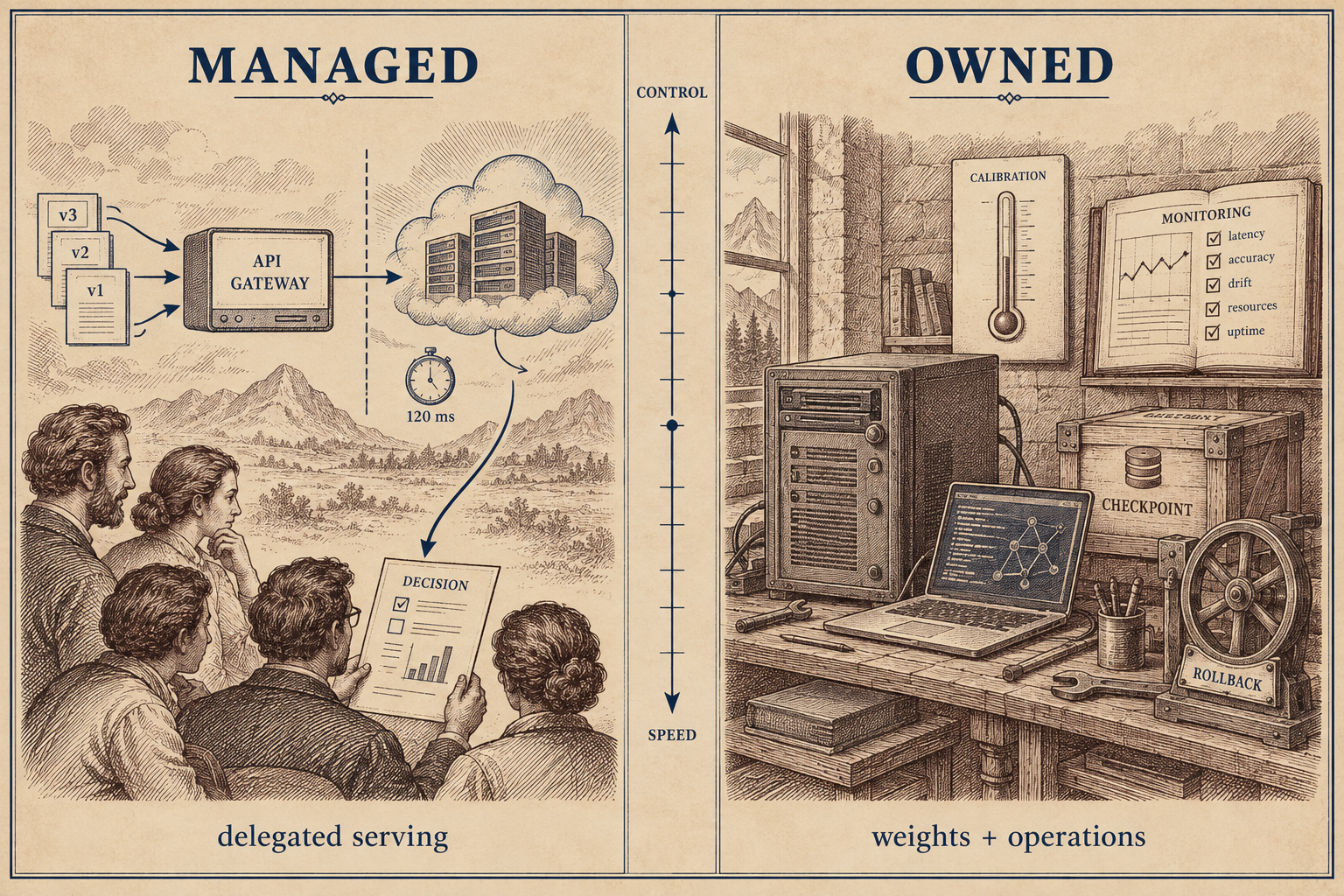
Jev is a walled garden ecosystem, built like what you would expect from a Western frontier lab. TypeSafe launched early access on September 15, 2026, shipping public Python and JavaScript and TypeScript software development kits (SDKs). You get an API console, keys, a test playground, usage metrics, and a default jev-latest alias that resolves to a pinned version behind the scenes. It is proprietary, closed, and hosted, giving you rapid integration if you are comfortable operating inside their perimeter.
Their launch pricing is $0.042 per million input tokens, with advertised latencies between 70 and 500 milliseconds. Keep in mind: those are vendor numbers. In an independent 300-example benchmark, hosted calls from Europe to Jev clocked roughly 236 to 256 milliseconds on small 4-way and 6-way tasks. At 72 labels, a local classifier took longer, and Jev pulled ahead. Network hops, physical geography, and candidate counts alter the math quickly.
A managed API buys time. You skip server provisioning, GPU availability panics, and model maintenance. If your compliance posture allows sending raw payload text over HTTPS and your traffic spikes unpredictably, an API is the fastest way to validate the concept.
Just do not confuse a clean developer console with enterprise validation. The public launch lacked verified enterprise case studies, published SLAs, support commitments, and data residency guarantees. Jev gives you a polished developer experience and offloads operations. Nothing more, nothing less.
One rule if you build on it: log the resolved model version, not just jev-latest. Dynamic aliases make updates effortless, but they turn regression tracking into guesswork.
Laya gives you the weights, and the operations that come with them
Convai Innovations took the opposite bet. Laya ships under the Apache 2.0 license on Hugging Face and GitHub. The family spans three ModernBERT and mmBERT checkpoints from 322 million to 421 million parameters. The safetensors files sit between 644 and 843 MB apiece, totaling 2.329 GB if you pull all three, according to the Hugging Face repository tree.
Ownership changes your posture completely. Data never leaves your VPC. You pin weights indefinitely, tweak the inference loops, calibrate on proprietary datasets, and control rollback. But you also inherit the operational baggage: GPU sizing, cold-start mitigation, monitoring, drift detection, and failover.
This mirrors what we keep stressing about the reality of open source AI bets. Open weights give you an exit ramp from vendor lock-in. They do not run themselves, and they do not magically reproduce training recipes.
Be precise about what runs locally. An independent MLX implementation clocked single-checkpoint execution on a 128 GiB Apple M3 Max at 13.42 milliseconds at the 50th percentile (p50) for English and 7.39 milliseconds for multilingual, pulling between 687.6 and 943.6 MiB of peak active memory. That proves local execution on high-end hardware. It does not mean it runs smoothly on a basic enterprise laptop, that three checkpoints fit in that memory envelope at once, or that on-prem inference costs nothing.
The project provides a fine-tuning notebook that adapts a checkpoint across 30,000 examples on two NVIDIA T4 GPUs in four to five hours. That makes fine-tuning remarkably cheap compared to training generative LLMs. You still need clean, labeled data, a held-out test split, and disciplined regression tests.
The evidence tells an honest, complicated story
Do not turn this into a horse race. There is currently no shared, identical benchmark evaluating Jev and Laya under the same prompts, test splits, and network conditions. Laya's documentation puts its internal measurements alongside Jev's public numbers, but they are not directly comparable.
The independent numbers on Jev are revealing. In the 300-example pilot, Jev 1.13.0 outperformed GLiNER2.5 on AG News and a 72-label Banking77 slice in both accuracy and selective coverage. On DAIR Emotion, the accuracy gap vanished. Even worse, Jev’s probability calibration degraded: a Brier score of 0.846 against GLiNER’s 0.668, and a negative log likelihood of 5.588 against 1.381. That study was small, 100 samples per dataset, but it highlights where confidence curves warp.
A broader same-harness decision benchmark tested Jev against eight structured LLMs and classical baselines. Nobody swept the board. Jev cost less and responded faster, but several LLMs beat it on raw accuracy. Those LLMs effortlessly swallowed 512 candidate choices; Jev threw an error on anything over 255. When fed deliberately ambiguous inputs, Jev acknowledged uncertainty on only 49.7% of items, while the LLMs caught it on 97% to 100%. Jev recorded an expected calibration error (ECE) of 0.246, worse than the 0.039 to 0.122 range achieved by the LLMs.
Laya's own benchmark repository is similarly transparent about its raw base weights. Its base English and multilingual models scored 0.362 and 0.342 on their typed-decisions benchmark, landing below the 0.461 majority-class floor. That 0.766 headline score you see in the marketing? It came from a model fine-tuned directly on that benchmark’s training set. Out of the box, the models are aggressively overconfident. Their ECE only dropped to usable levels (0.081 for English, 0.106 for multilingual) after applying temperature scaling on held-out splits.
The most dangerous failure mode is domain shift. Laya’s English checkpoint scored 0.0% accuracy on Khmer text while outputting a 95.2% average confidence score. Confidence scores do not recognize scripts they were never taught. Cardinality is another trap. Laya degrades when option lists crowd out input context, and Jev simply refuses to run past 255 choices.
None of this ruins the architectural premise. It just means you measure calibration, coverage, and context limits instead of buying into marketing claims.
The counterargument: maybe this is just better packaging
A skeptical architect will point out that you can already glue together regex rules, a standard classifier, and an LLM running constrained decoding. Modern structured output engines mask invalid tokens at the logits layer. The syntax problem is solved. Why invent a whole new tier of software?
That skepticism is valid on syntax. It falls short on operational reality. The test is whether a purpose-built model gives you tighter calibration, predictable latency under heavy load, lower cost per completed decision, and an audit trail that security teams can actually review.
If a vendor wants you to treat this as a standalone category, demand proof on your own production data. You need deterministic schemas, versioned artifacts, dependable probability scores, bounded latency, and graceful failure. "Zero hallucinations" is a sloppy claim. A model restricted to selecting from an enum cannot emit broken text, but it can still route a wire transfer to fraud when it should have gone to review.
Models estimate. Application code holds the keys.
Let a decision model calculate an urgency score, classify intent, or flag an anomaly. Keep identity checks, permission gates, business rules, math, thresholds, spending caps, retries, and circuit breakers in your application code. Leave high-stakes decisions affecting people's health, employment, credit, or legal status in the hands of human operators.
The model estimates. Policy decides whether and how that estimate may affect action.
This is the bedrock of trustworthy architecture. A model does not earn authority just because its payload matches a TypeScript interface. Your software sets the thresholds, checks the context, and routes low-confidence predictions to human review.
As we covered in our guide to practical AI governance, governance relies on clear authority, observable evidence, and human stops. A probability score cannot approve its own action.
Treat inbound emails, tickets, and user prompts as untrusted payload data. Verify that prompt injections cannot manipulate your options or trick the model into returning a high confidence score. Track false positives and false negatives weighted by their real-world cost, not just overall test accuracy.
The buyer's evaluation playbook
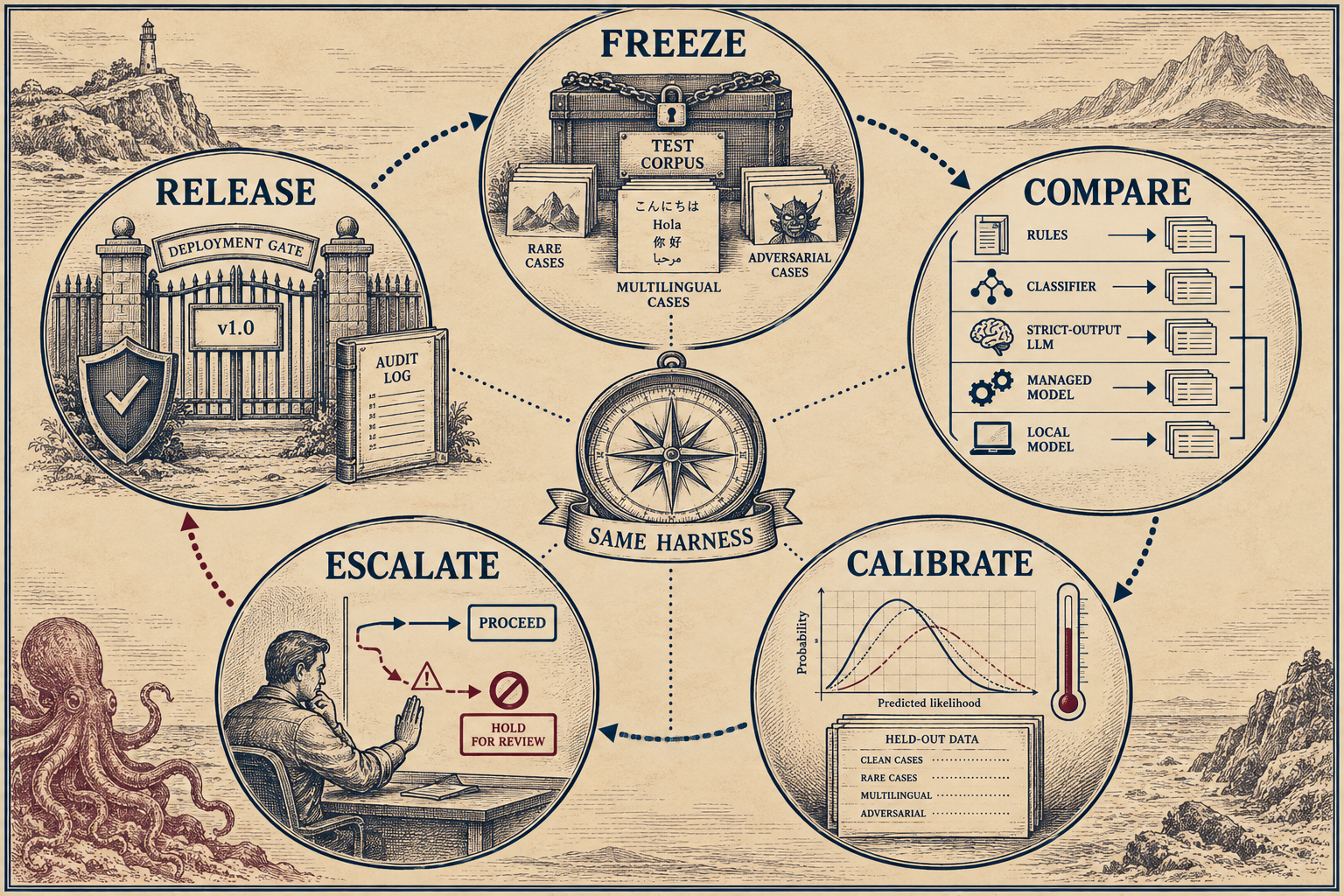
Start by locating the ambiguity. What human nuance are your hardcoded rules failing to capture? Define the downstream action, the mandatory security checks, who signs off, and what a catastrophic error looks like. Build a frozen test dataset with messy real-world edge cases: missing fields, foreign phrases, prompt injections, and historical boundary disputes.
Evaluate your options within a single test harness:
- Current business rules alongside basic majority-class controls.
- A standard classifier trained on your historical tags.
- A general LLM with native structured output, tracking every retry and token.
- Jev pinned to an exact version string.
- Laya's base weights alongside a checkpoint fine-tuned on your domain.
Look beyond simple accuracy. Track macro-F1 across classes, Brier scores, negative log likelihood, calibration error, and how often option ordering flips the answer. Measure p50, p95, and p99 latency, cold-start delays, memory consumption, failure rates, compute spend, API costs, and human review time.
Audit your permission boundaries. Verify what happens at every confidence tier: when the code acts automatically, when it pauses, and when it alerts an operator. Confirm that no input payload can force an automatic action without passing deterministic checks. Re-run this entire suite whenever a model, prompt, or schema changes.
Stick with simple rules when the logic is deterministic and easy to audit. Pick a classical classifier when you have clean labels and thousands of historical examples. Reach for a full-size LLM when you need open-ended generation or complex reasoning across many variables.
Choose Jev when you want immediate integration, variable throughput, and zero GPU overhead, assuming your data policies permit external APIs. Choose Laya when you need complete network isolation, weight ownership, and custom fine-tuning, and your engineering team can manage ML operations. Neither choice earns trust without real benchmarks.
Count the full loop in your cost model. Jev's token pricing and Laya's lack of an API bill do not represent your true cost per decision. Factor in retries, network transit, GPU instances, calibration data prep, monitoring, and human review time. As we showed in our breakdown of enterprise AI cost traps, hard financial caps are the most effective way to keep agentic loops from spiraling out of control.
Earning a place in the stack
Jev and Laya point to a genuine architectural need. Enterprise software cannot hand unconstrained generative models control over critical business logic, yet simple boolean rules crumble in the face of human ambiguity. A typed decision model steps cleanly into that middle ground.
Whether this becomes an enduring category depends on how the models perform in the wild. Strict JSON extraction already handles basic formatting. Jev's independent calibration numbers show real room for improvement. Laya's base weights struggle on unseen benchmarks and can confidently misfire on unfamiliar languages. Its local efficiency is impressive on a 128 GiB M3 Max, but that is hardly standard-issue laptop hardware. Nobody has published a definitive head-to-head evaluation yet.
That gives you more than enough reason to test them on your own terms. In our own work integrating Jev into retrieval and web crawling infrastructure like SlopSearX and GroktoCrawl, the early results have been remarkably promising. Swapping out verbose, generative prompt loops for bounded decision calls brings immediate benefits: latency drops sharply, operational expenses shrink, and pipeline outcomes become consistently predictable.
If you lead an engineering organization, do not wait for the marketing dust to settle. Run focused learning spikes right now. Identify the two or three places in your architecture where brittle regexes break or expensive LLMs are merely picking a path, and drop in a decision model. Keep model outputs bounded. Keep business rules in deterministic code. Keep high-impact decisions in front of accountable humans. Probability only earns a place in your stack when it proves itself in production.