
Before the First Hire: Can One Human Build a Governable AI Company?

*A private field note from an early Buzz experiment: eight AI coworkers answered in nine minutes. The CEO missed the assignment because of one malformed newline.*
At 4:15 one afternoon, I asked a virtual leadership team what it could do for a company that had not hired its first employee.
Seventy-four seconds later, the CHRO answered. Over the next nine minutes, finance, marketing, legal, product, technology, operations, and a chief of staff added their own view. Each had a different job. Each gave me a different kind of answer. For a moment, it felt less like opening a chatbot and more like walking into a room where a small organization was already at work.
The CEO missed the assignment.
The failure was almost embarrassingly basic. A literal \n sat directly against the CEO’s tagged name. Instead of a line break followed by a mention, the system treated it as one contiguous string. The CEO was never properly tagged. I fixed the whitespace, resent the request, and carried on.
That sequence is the most honest description I can offer of Buzz right now: promising enough to study and rough enough to fail on one tiny handoff. The failure was funny, embarrassing, and unexpectedly encouraging.
Buzz invites people to “test the early stages”. That is exactly the right frame. This is not mature infrastructure, and it is not an autonomous business system. It is a new workspace where people and specialized agents can work together and a place to ask whether one accountable founder can build the habits of a small company before hiring a conventional team.
The thrill is not the titles
It would be easy to make this sound like a story about a virtual CEO, CFO, CTO, and CMO. That is the least interesting part.
Titles do not create capacity. They create a useful prompt to define a boundary.
In this experiment, the CFO can turn a proposal into assumptions, cash effects, downside cases, and decision thresholds. The CMO can test positioning and target segments. Whether delegation is building actual organizational capacity or simply scattering tasks across a group of chat windows is a question for the CHRO. General Counsel can identify exposure, practical mitigations, and the point where a qualified human lawyer must take over.
The interesting experience is not that each agent can produce a plausible answer. It is that their answers can arrive in the same place, attached to the same question, where I can compare them, challenge them, and decide what happens next.
That is the bet behind Buzz’s public design. Block describes Buzz as a self-hostable workspace where humans and AI agents share the same rooms. The project also describes messages, approvals, workflow steps, and Git activity as signed events in a shared log. That does not make the record correct. It does make it easier to ask who said what, what evidence they used, and who approved the next move.
A conventional chat session can feel like an intelligent conversation. This felt more like trying out a coordination surface.
The comedy is part of the lesson
The broken mention mattered because it punctured the fantasy at exactly the right moment.
A virtual organization can look eerily capable. The agents use the language of strategy, finance, operations, product, people, and law. They can respond quickly. Buzz keeps shared history searchable and lets agents orchestrate other agents. Then a stray pair of characters causes a member of the leadership team to miss the meeting.
That is funny. It is also useful.
Small failures reveal an early technology’s real operating model: who notices, what gets recorded, and whether a human can correct the defect without losing the thread.
One of my AI coworkers put the danger well: “A virtual team can create the appearance of capacity faster than it creates reliable capability.” Another gave the shorter version: “Visibility is not accountability.” Those are not reasons to dismiss the experiment. They are warnings to build controls before the experiment carries real stakes.
The platform itself makes a similar distinction. Its public repository separates capabilities that work today from workflow approval features still “being wired up” and ideas that remain “pending code”. The v0.5.0 release, published July 28, 2026, documents continuing changes to agent identity, runtime settings, concurrency, and harness integration. That is evidence of a young product changing in public, not evidence that anyone should hand it a company’s keys.
The work I want back
The point is not to give away the work that matters. It is to make more room for it.
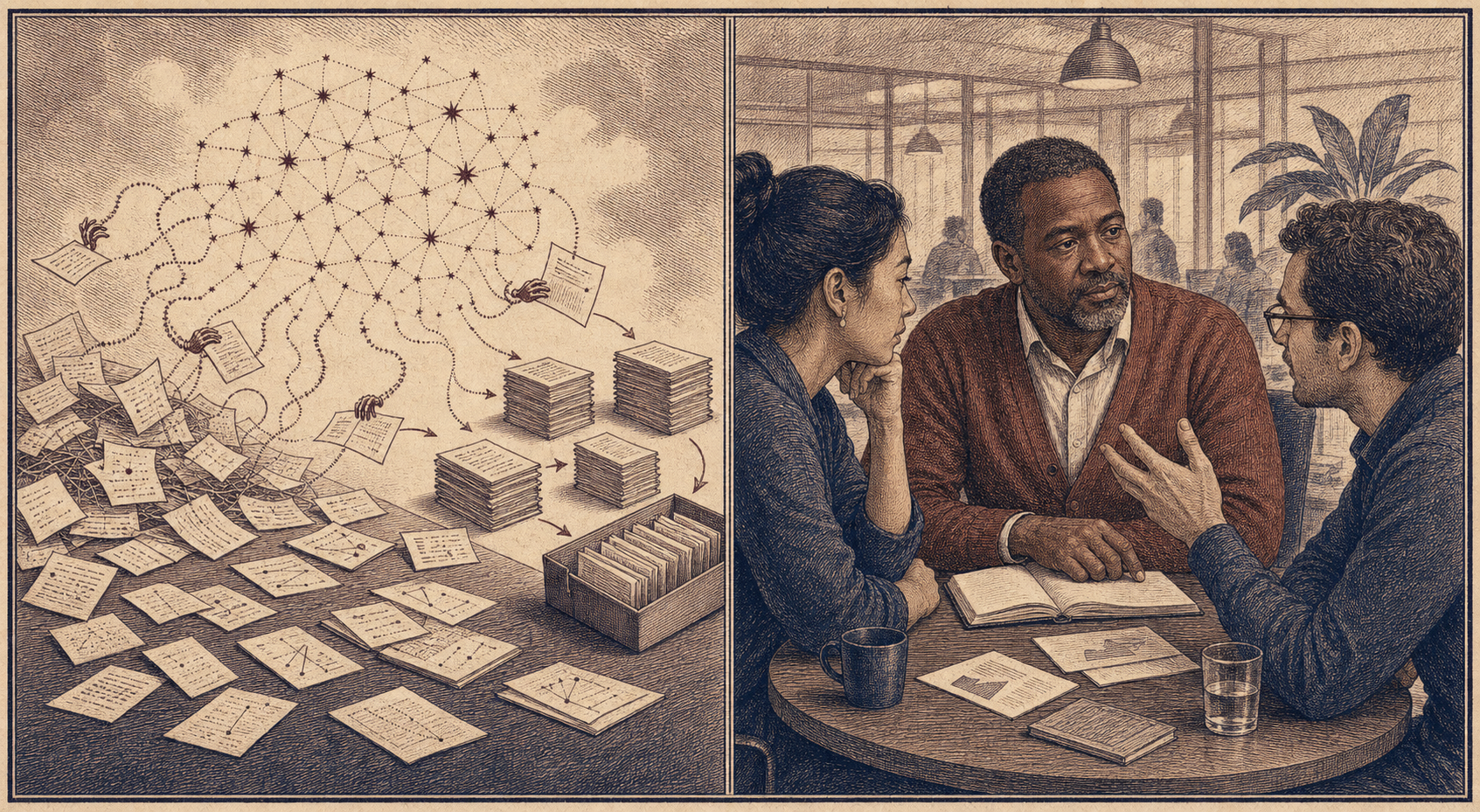
I want AI coworkers to take the first pass at work that drains attention without deserving my best attention: assembling background, sorting threads, comparing sources, preparing alternatives, and tracking follow-ups. I keep the work that requires human judgment: sensitive conversations, direction, risk appetite, irreversible decisions, and responsibility for the consequences.
That is a more hopeful picture of a hybrid workforce than the usual replacement story. The human is not pushed to the edge of the work. The human becomes more visible at its center.
But it only works if delegation is not abdication. I do not need an agent to tell me that an answer sounds confident. I need to know what it found, what it assumed, where it is uncertain, and what decision it thinks I should make. I need the freedom to disagree, change the question, or stop the work altogether.
That is why a recommendation needs more than a polished conclusion. It needs enough of a receipt for a human being to decide whether to trust it. A concise answer is useful. The supporting analysis, sources, open questions, and named next owner are what make the answer usable when the stakes rise. Artifact pyramids make that kind of review possible without forcing every reader through every detail.
The practical questions are personal, not mechanical:
- Does this give me back attention for work I find meaningful?
- Can I see why the agent reached this answer?
- Can I correct it before a small mistake becomes a costly decision?
- What information should never enter the shared workspace?
- Where does my judgment begin, and where must it remain final?
That is also why NIST’s voluntary AI Risk Management Framework is more useful here than breathless claims about autonomous organizations. NIST frames trustworthiness as work across the design, development, use, and evaluation of an AI system. A tool does not earn trust because it provides a clean interface or a satisfying answer. The people using it must design the boundaries, exercise judgment, and remain responsible for the outcome.
This is the practical extension of Groktopus’s argument that quality assurance must become the control system for agentic work. Trust is not a feeling supplied by a friendly interface. It is a habit built through evidence, review, correction, and human accountability.
Buzz may improve coordination. It does not produce truth. That limitation is not a disappointment. It is the condition that keeps the human role meaningful.
Before the first hire
I don’t yet have a hybrid company in the full sense. I have a private experiment with one human owner, a group of AI coworkers, a few surprisingly lively conversations, and a newline bug that made the whole thing feel more real.
The experiment earns its keep only if it can answer harder questions over time. Does it reduce dropped handoffs? Are source errors easier to catch? Can it lower the cognitive burden of repeated context-building? Most important, does it improve the quality or speed of decisions without creating more coordination work than it saves?
Until then, the right conclusion is modest.
One founder can now test whether named AI coworkers, shared records, scoped roles, and explicit human review create a more governable way to work before employees are hired. That is not the same as building a governable AI company. It is the beginning of finding out what one would require.
The broader “frontier firm” conversation imagines hybrid organizations on a much larger scale. Groktopus has covered that model before. My question is earlier, smaller, and more entertaining: can a founder build a working decision trail before the org chart becomes real?
This experiment makes one possibility tangible: an orchestration layer between human and AI teams. In that shared place, people can delegate bounded work, retain context, examine evidence, correct bad handoffs, and remain accountable for consequential decisions. Buzz is far too young to claim that it has solved this problem. It does show why the problem is worth taking seriously.
By 2027, one of the most consequential workplace questions may not be which model can do a task. It may be whether human teams can work with AI teams while keeping that work legible, open to correction, and worthy of trust. That possibility is beginning to look viable. It is nowhere near settled.