
AI Gives Workers Time Back. The Best Companies Give Them Agency.

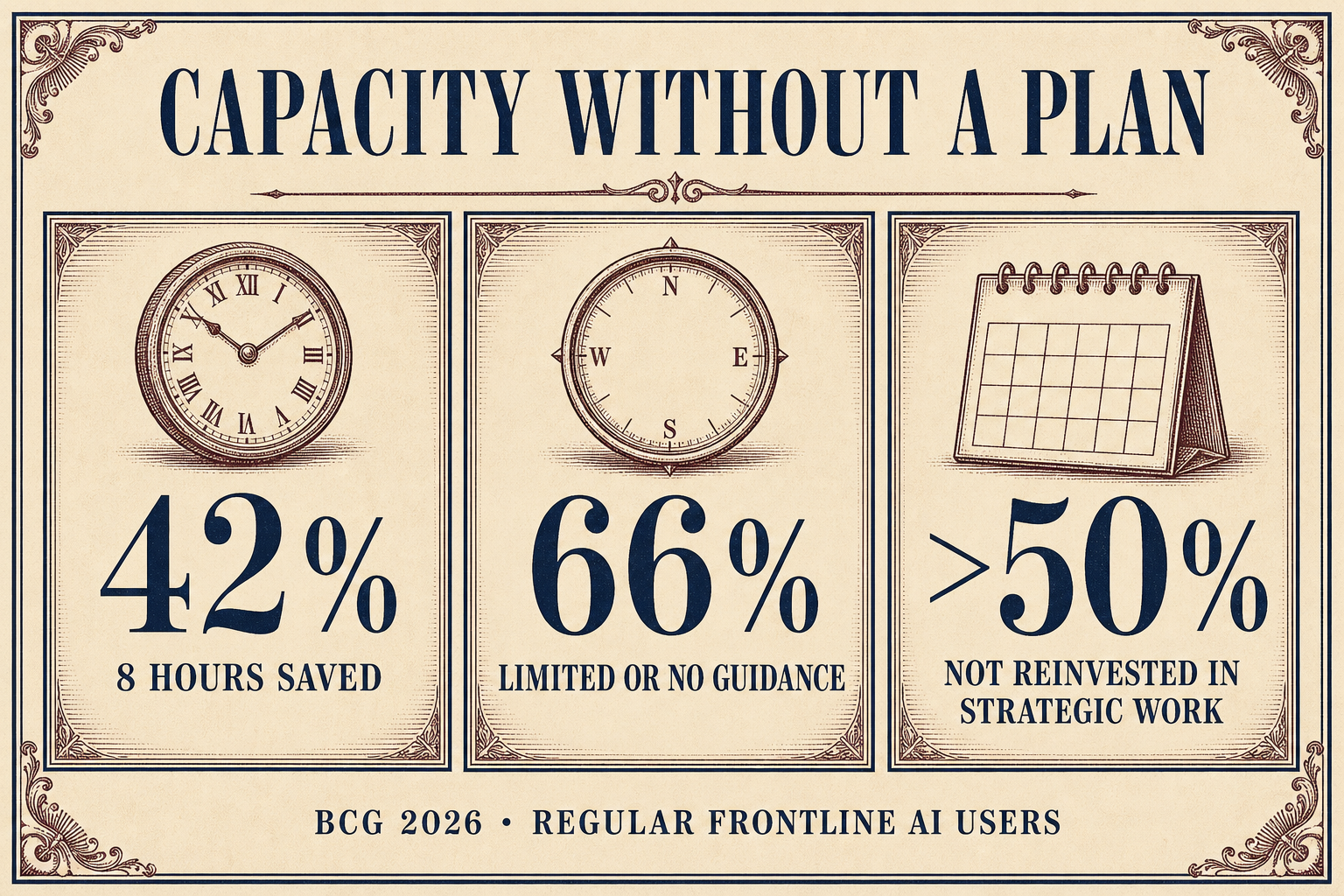
Eight hours. That's the number most executives will circle in the deck. A 2026 BCG survey of nearly 12,000 employees, managers, and leaders across more than a dozen markets found that 42% of regular frontline AI users said they saved eight hours in a week. That finding is narrower than the headline version: 42% of regular frontline users, not 42% of all workers, and the hours were self-reported. Nobody stood behind them with a stopwatch.
I don't doubt the capacity signal. I doubt the assumption that usually follows it: if a worker finishes this kind of work eight hours faster, the organization will fill those eight hours with more of the same.
That is capacity, not agency. The better move is to spend some of the recovered time on responsibilities that routine work has pushed aside: improving the process, helping customers with harder problems, learning the domain, or fixing recurring defects that nobody had time to address. That work is harder to count. It is still part of the job.
Time saved means a task took fewer minutes. Agency returned means the worker has some say in what happens next. Can they help redesign the work? Can they use the recovered time to do work the queue kept postponing? And when the system is wrong, do they have room to challenge it? If the queue clears earlier and someone quietly raises the quota, the job got faster. It did not become freer.
What happens to the recovered time?
Saved time doesn't allocate itself. In the same BCG survey of regular frontline AI users, 66% said they received limited or no guidance about what to do with the time they saved, and more than half said it was not being reinvested in more strategic work. From the worker's side, that ambiguity is not abstract. You finish sooner, then wait to find out whether the recovered hour belongs to you, the backlog, a training plan, or next quarter's cost target.
The survey can't tell us what each person wanted. Some may have wanted clear direction. Others may have wanted room to decide. Most probably needed a real conversation about both. What the data does show is simpler: buying the tool did not settle how the job should change.
This confusion didn't begin with the latest model release. The 2024 Microsoft and LinkedIn Work Trend Index combined a survey of 31,000 people in 31 countries with product and labor-market signals. It reported generative AI use among 75% of global knowledge workers while many leaders still lacked a plan for turning individual use into organizational change. This was vendor research about knowledge work, and it measured adoption and planning, not autonomy. Even with that limit, the gap is hard to miss: people were already using the tools while the job around them remained largely undesigned.
We have argued that the org chart can become AI transformation's rate limiter. Saved time is where a rate limiter stops sounding like strategy jargon and starts shaping someone's afternoon. Picture the ordinary version: Monday's recovered hour goes to training, Tuesday's disappears into another queue, and by Friday the target has moved. Nobody ever says who owns the time. The strongest local incentive decides by default.
Time back can arrive with a heavier job
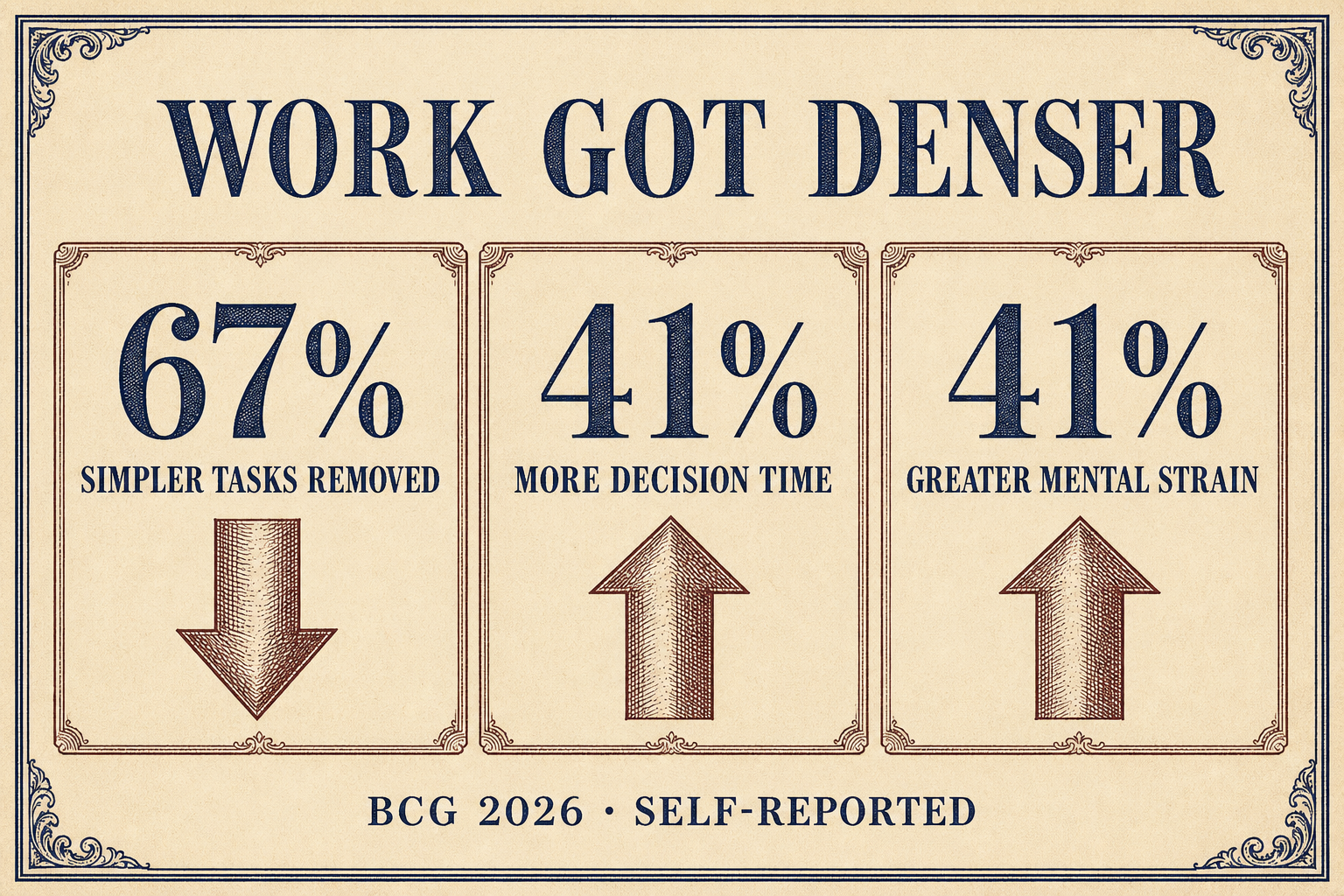
Here is the part workers notice before the dashboard does: remove the easy cases, and a shift can get harder even when it gets shorter. BCG's frontline respondents reported that AI had taken over simpler tasks and left more complex work in 67% of cases. In the same survey, 41% said AI increased the time they spent making decisions, and 41% reported greater mental strain. Those are self-reports, not clinical measures or proof that AI caused the change. They still puncture the pleasant story of an assistant quietly carrying away the drudgery.
People increasingly call this AI fatigue: the strain that comes from keeping up with constant workplace change, new tools, and the pressure to use them. Treat the phrase as a workplace description, not a medical diagnosis. The underlying problem is concrete enough: more software can leave a person with more decisions, more checking, and less room to recover.
Think about a support rep after the routine questions move to a bot. Nearly every case that reaches a person is unusual, emotional, or already going badly. There are fewer easy tickets between the hard ones. An analyst may spend less time making a first draft, then spend the afternoon deciding whether a polished answer is subtly wrong. Review is faster right up until it isn't.
An hour removed from production can come back as exception handling, verification, judgment, or customer repair. That work may be more valuable. It may even be more interesting. It is also denser and less forgiving. A dashboard can show fewer minutes per task while missing the worker who now spends the whole day in the red zone. Track elapsed time, output quality, rework, and human load separately. Calling all of it “productivity” hides the part people have to live with.
Agency requires four design decisions
Agency stops being a fuzzy employee-experience word once you ask who can make which call.
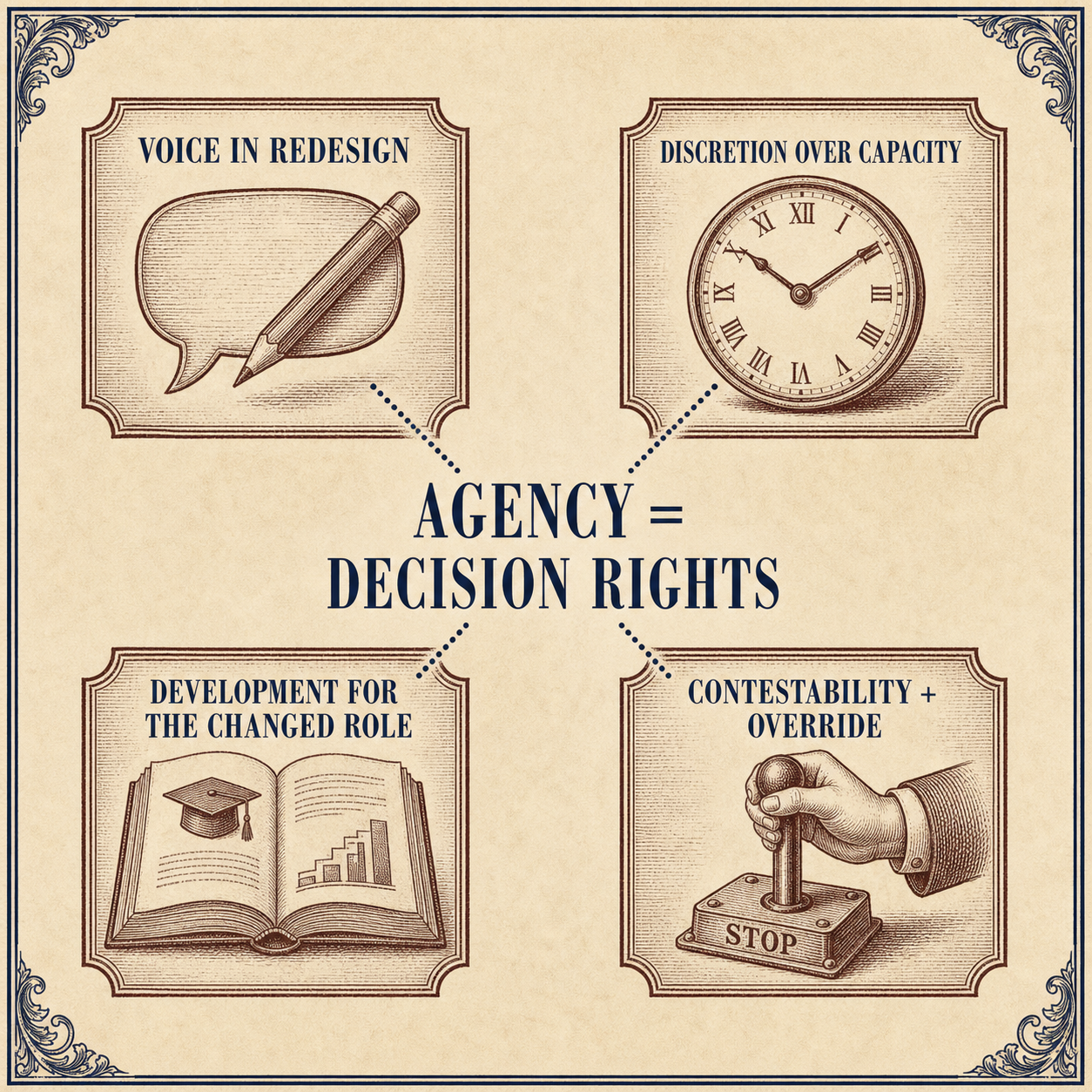
- Let workers change the design. The people doing the work can see where the handoffs break, where the model guesses, and which “efficient” step creates repair work later. BCG's analysis recommends involving employees in redesign, but a listening session with no power to change the workflow is theater.
- Say who owns the saved time. Teams need an agreement about what can go to customers, process improvement, learning, recovery, and new responsibilities. A worker should not discover the policy one rising quota at a time.
- Rebuild the way people learn. Easy repetitions are often where a novice learns the shape of the job. If the machine takes those repetitions, the company cannot simply demand expert judgment sooner. It has to fund practice, shadowing, feedback, and time to get good.
- Make “no” usable. If a worker remains accountable for the result, they need the evidence, permission, and time to reject an AI recommendation. Responsibility without authority is not augmentation. It is a liability handoff.
This is why AI governance remains human work. For the person at the keyboard, governance is not a committee deck. It is whether the escalation path works, whether review time is staffed, and whether pressing stop damages a performance score.
A plan matters when a worker can feel it
Gallup's 2026 reporting on U.S. employees found a 15-point engagement difference between employees who said their organization had a clear AI integration plan and those who did not. Engagement was 48% among employees reporting active manager support, compared with 30% among those without it. Among frequent AI users who also reported a clear plan and active manager support, engagement reached 53%.
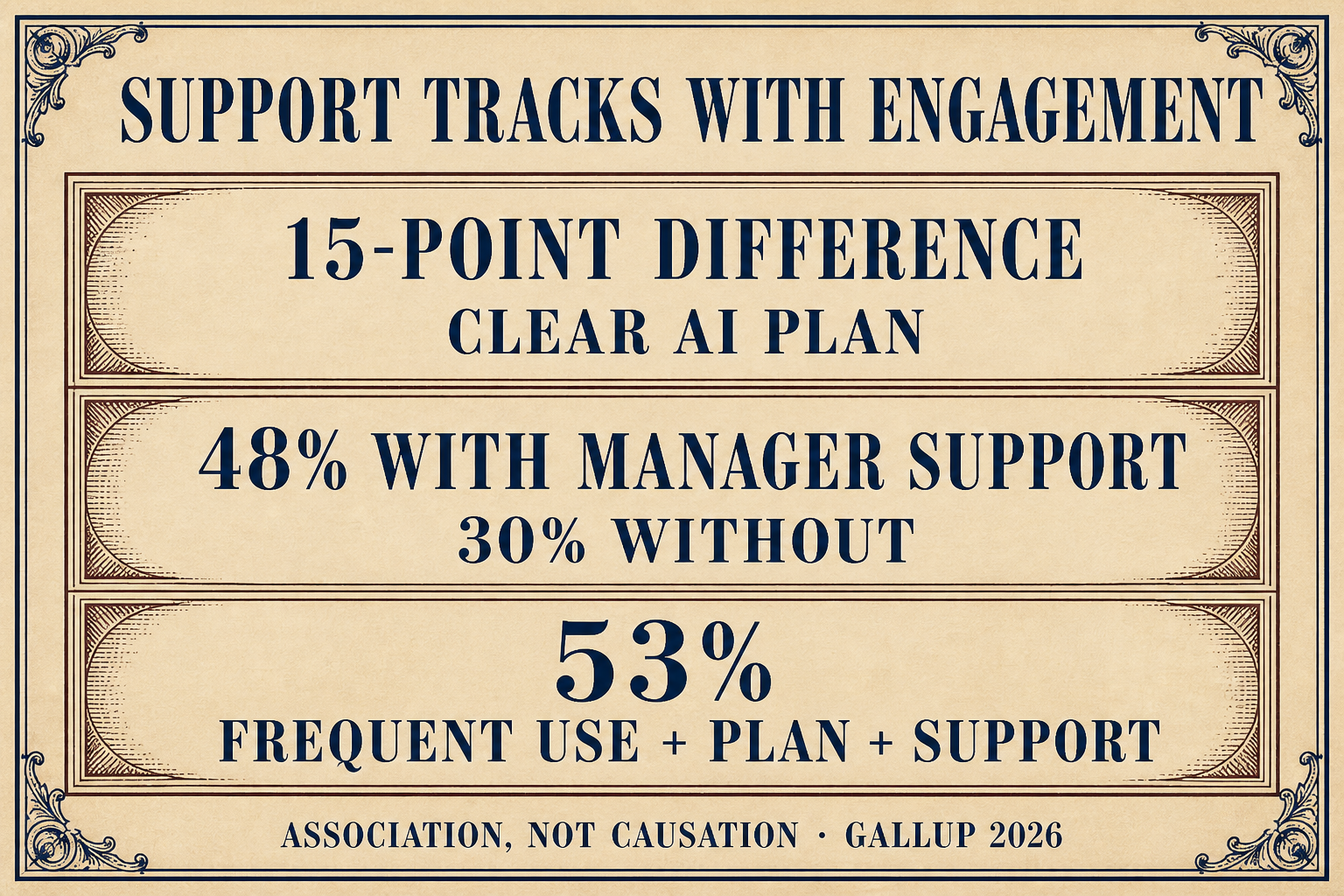
Those gaps are large. They are not proof that the plan or manager caused engagement. Gallup explicitly notes that industry selection may explain part of the gap, and the productivity result came from employees' ratings rather than an objective output measure. That is an important limit. The worker-level question is still worth asking: Do I know what this tool is for here, and will my manager help when the changed job gets messy?
A manager who counts prompts has missed the job. The useful work is closer to traffic control and cover: decide where AI belongs, protect time for practice, notice when a quick answer creates half an hour of review, and make escalation safe. Support has to become something a worker can use: “Pause the system. Spend the hour learning. You won't be punished because a difficult case needed care.” Prompt count is not the outcome. The job should actually get better.
IKEA shows redeployment, not automatic agency
IKEA gives us a case where the employer at least tried to redesign the role instead of treating a bot like an eject button. Fortune reported that Ingka Group retrained roughly 8,500 customer-service employees over two years as its Billie bot handled routine questions and people moved toward complex resolutions and remote design sales. That is more deliberate than installing a bot and waiting for the labor line to shrink.
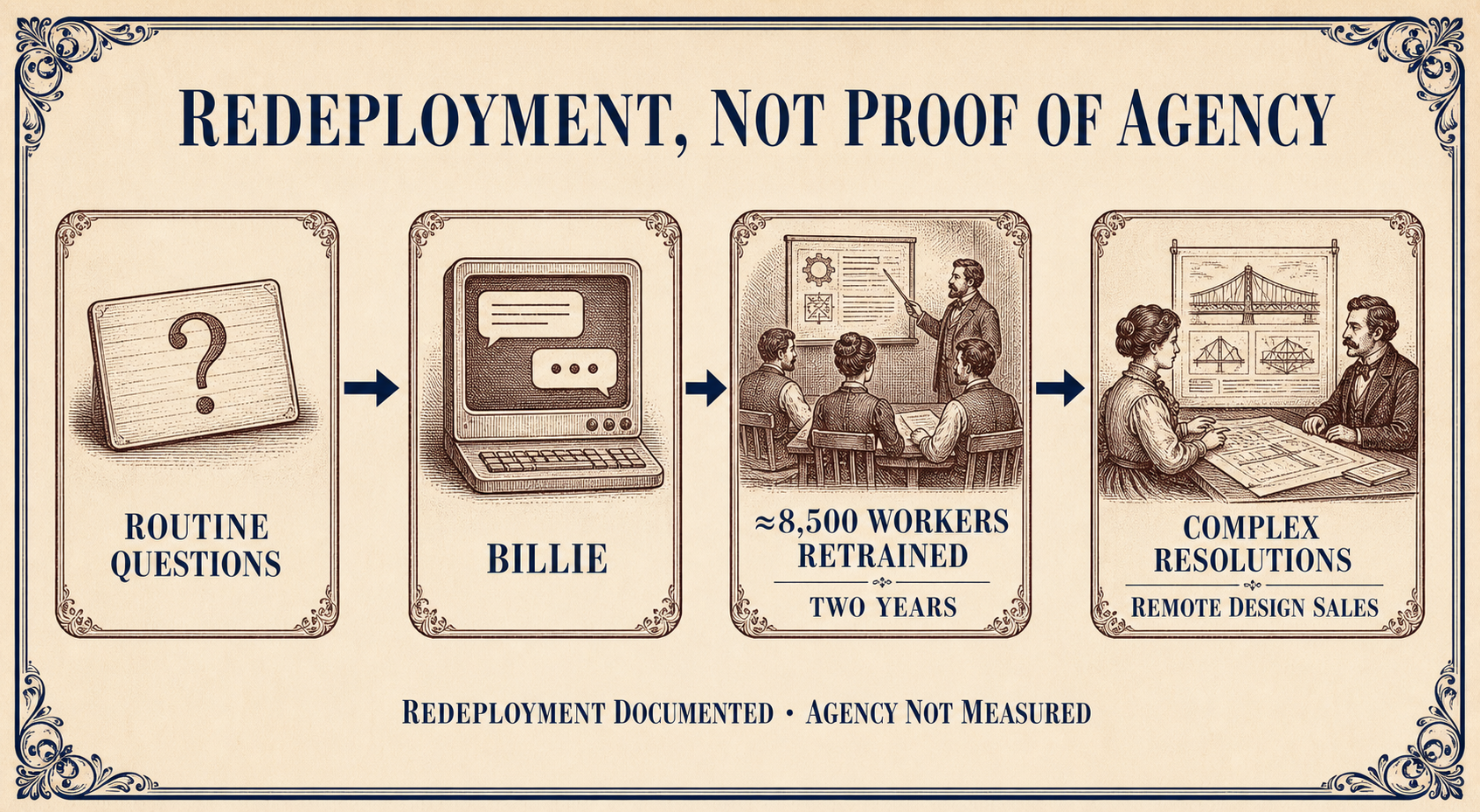
On paper, the operating results look strong. Fortune also relayed IKEA's operating figures: remote-sales centers had grown 15% to 20% annually over three years, produced €1.25 billion in the latest fiscal year compared with €1.08 billion the year before, and reached an 89% in-house customer-happiness score compared with 60% before Billie. Those figures came from IKEA. The business was also changing through e-commerce growth and restructuring, so the report cannot isolate what AI or retraining caused. It does not show that every worker chose the new role or prove that reskilling prevented layoffs.
Now stand on the worker's side of that move. A routine question disappears. In its place comes a frustrated customer, a design consultation, or a sale that requires judgment. That can feel like a promotion when training, pay, mobility, and sane workloads follow. Without them, it can feel like being handed the hardest work all day and being told automation helped you. The public case does not tell us which experience each worker had. It shows redeployment, not automatic agency.
Human override is a performance control
A capability frontier is a neat phrase in a report. At work, it feels like this: the system produces a polished answer, something about it smells wrong, and your name is still attached to the result. In an experiment involving more than 700 BCG consultants, MIT Sloan reported that GPT-4 improved performance on a task inside the model's capability frontier by 38% without an overview and 42.5% with one. On a task designed outside that frontier, performance fell by 13 and 24 percentage points, respectively.
The experiment used short, simulated consulting tasks and GPT-4-era systems. It did not measure long-term job quality, wages, retention, autonomy, or every current model. The practical lesson is narrower and sturdier: apparent competence fails at the boundary. If a company keeps accountability human, it has to keep validation time and override authority human too. Otherwise, the worker becomes the last line of defense without being allowed to act like one.
Write a capacity contract before scaling
Before saved time becomes a fight over quotas, put the answers in writing. Not another values statement. A working agreement that a manager and a worker can both use on a busy Tuesday.
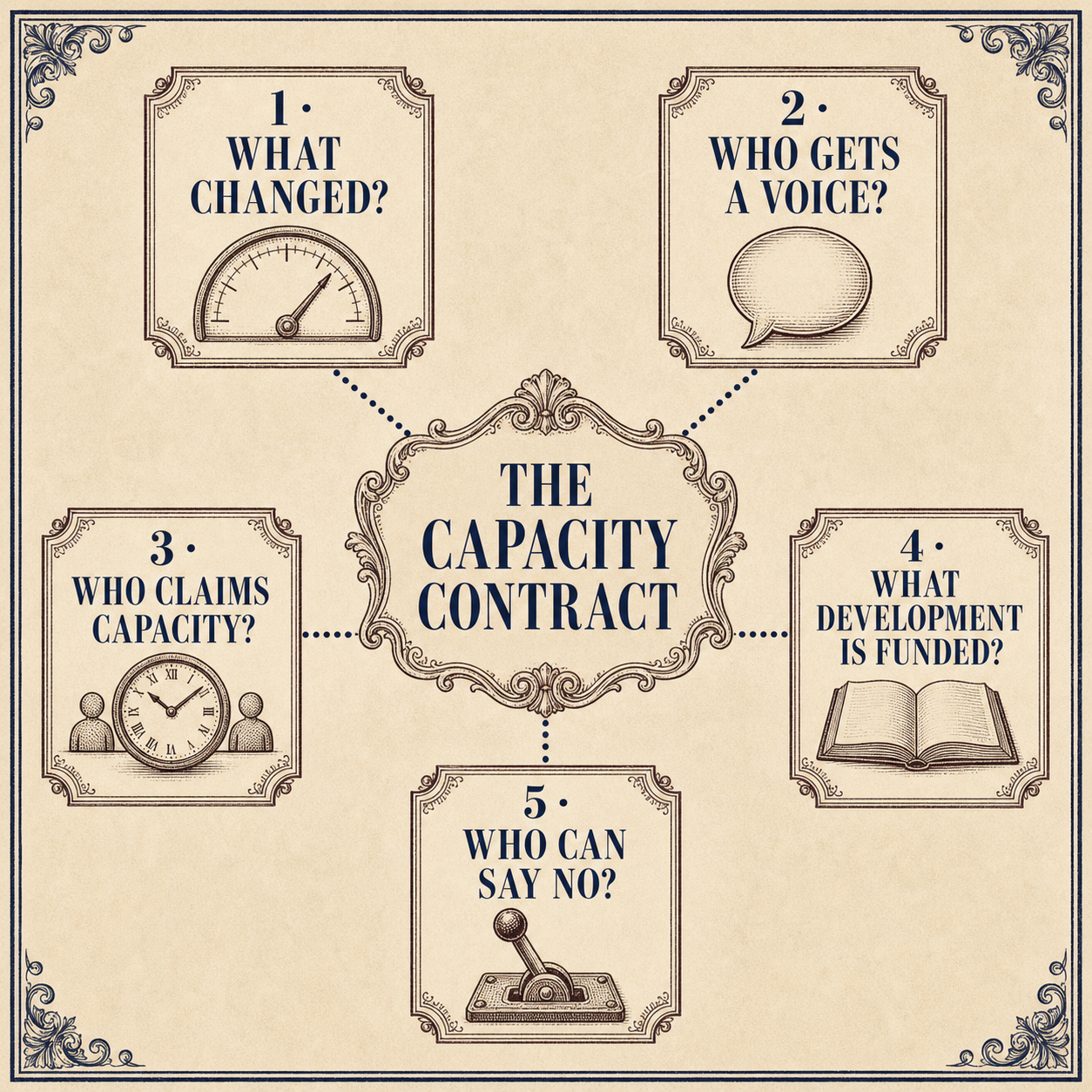
- What actually got better? Do not stop at task time. Track output quality, rework, decision load, error burden, and the pressure of the changed day.
- Who gets to redesign the work? Give the people doing and receiving it a defined role in testing, changing, and escalating the workflow.
- Who owns the recovered hour? State how workers, teams, customers, and the business will share the benefit. Do not let the next quota claim it silently.
- How will the job change? Tie new responsibilities to training, practice, compensation, and a credible path forward.
- Who can stop the machine? Name the human authority to pause, challenge, or override the system without punishment for slowing it down.
I use “best companies” in the title as a standard of conduct, not an empirical ranking. No cross-company benchmark in this evidence package tells us which employer has returned the most agency. The useful test is closer to the work. Watch who controls the time and who carries the new load. Then ask whether the worker can say no.
AI can make a task faster. It can't decide what happens to the worker at 3:30 when the queue is clear but the day isn't over. That hour can become another target, a thinner team, a chance to learn, a better process, or room to breathe. Management makes that choice, even when it pretends the tool made it.
Giving time back is a tool result. Giving agency back is a management decision.