
Healthcare AI Should Make Care More Human

In clinical practices across the country, nurses and physicians spend roughly two hours of administrative work wrapped around every single hour they spend with a patient. Some of that time is burned before the visit, digging through disjointed charts and hunting down prior notes. Some of it is lost after the patient leaves, closing out documentation, routing orders, and coordinating follow-up. That overhead is real clinical work. Charting, diagnostic reasoning, and medication reconciliation are genuine components of medicine. But when the clerical machinery wrapped around the encounter devours the working day, the humans trained to heal have little room left to listen, explain, notice subtle distress, or follow through.
The breakdown does not end when the clinic doors lock. In my work leading healthcare technology, I have watched the handoff between acute care and outpatient recovery repeatedly fracture. Discharge summaries sit incomplete or arrive days late. Care coordinators are left flying blind, unable to see which vulnerable patients just left the hospital and need immediate intervention. When the record fails to carry the momentum of care forward, patients slip into the void between encounters.
Artificial intelligence in healthcare should make medicine more human, not more mechanical. More presence from an unhurried clinician, more dependable follow-through between visits, and more breathing room for genuine patient connection are real payoffs, even when financial analysts cannot spot them on a quarterly operating margin chart. The danger is that health system leadership falls into the throughput trap: treating recovered time as an excuse to pack three more rushed appointments into an already exhausted day, calling that productivity, and wondering why staff continue to quit. The real prize is returning capacity to where human clinical judgment matters most, while expanding access only when an organization can do so without breaking its people.
An Apollo analysis by chief economist Torsten Slok recently asked where the broader economic return from AI has gone, pointing out that revenue per worker and operating margins have barely budged outside mega-cap technology firms. Healthcare executives are right to ask that very question. Enterprise software licenses, EHR integration, staff training, clinical review committees, and continuous monitoring all demand significant capital. But corporate profit margins cannot tell a chief medical officer whether a primary care doctor had enough time to comfort a grieving family, or whether a critical post-discharge prescription was actually filled.
Buying back attention around the encounter
Every patient encounter unfolds across three distinct chapters: the preparation before entering the exam room, the conversation during the visit, and the documentation that trails behind it. Today, clinicians are drowning across all three.
In a landmark direct-observation study by Christine Sinsky and colleagues evaluating 57 physicians across four specialties, electronic health record tasks and desk work devoured 49.2 percent of observed clinic time. Direct, face-to-face patient interaction accounted for just 27.0 percent. Even inside the examination room, doctors spent more than a third of their time focused on computers rather than looking at the person sitting on the examination table. While desk work certainly includes essential clinical reasoning, the imbalance reveals the absurd tax modern software has imposed on healers.
Before a visit begins, intelligent synthesis can pull together disjointed medical histories, lab trends, and specialist notes, allowing a physician to enter the room holding the continuous thread of a patient's story. During the visit itself, ambient documentation tools can remove the physical barrier of the computer screen. A prospective time-motion study in Singapore observed that when doctors used an ambient AI scribe, the proportion of the consultation spent maintaining direct eye contact with patients climbed significantly, while overall visit length remained stable. That shift captures the payoff that actually matters: deepening human connection rather than rushing people through an assembly line.
There is another, quieter capability ambient listening can unlock inside the room: catching shifts in a patient's social determinants of health that are easy to miss in the rush of clinical dialogue. Patients rarely frame social distress using the clinical vocabulary of an intake form. They do not announce food insecurity or housing instability. Instead, they drop an offhand remark about stretching a thirty-day prescription to last six weeks, turning the heat off in part of the house, or losing the neighbor who gave them rides to the pharmacy. When a physician or nurse is focused on diagnostic reasoning, physical examinations, and medication reconciliation, those faint disclosures can easily slip past undetected. An ambient system listening in the background can identify those subtle conversational cues and offer timely insight to the provider, prompting them to slow down, explore the change in the patient's lived circumstances, and evaluate whether it warrants modifying the care plan. Catching that reality in the moment allows the clinician to adapt, whether by switching to an affordable generic, simplifying a regimen, or bringing in a social worker and care coordinator before the visit ends.

After the encounter concludes, automated charting can dismantle the dreaded burden of "pajama time," the hours clinicians spend finishing documentation at home late into the night. A randomized outpatient trial of 238 physicians demonstrated measurable relief, finding that Nabla reduced EHR note-writing time by 9.5 percent, while DAX Copilot showed a smaller 1.7 percent reduction that crossed the neutral threshold.
What happens next is an organizational test. When an AI scribe gives twenty minutes back to a clinician, health system executives face a clear fork in the road. They can harvest those minutes as crude throughput, cramming another patient into an already frantic schedule, or they can reinvest that capacity into longer conversations for complex cases, dependable discharge coordination, and sustainable working conditions. Reinvesting that time is not a soft sentiment; it is the fundamental boundary between transactional automation and sustainable healthcare delivery.
Keeping patients from falling through the gap
The space between appointments is where healthcare either delivers on its promise of continuity or falls apart completely.
In value-based healthcare, operators constantly track care gaps: clinical actions a patient should receive according to evidence-based guidelines, such as an annual diabetic foot check, a screening mammogram, or follow-up after an abnormal lab result. But there is a vital distinction between a genuine clinical care gap and a mere data failure. If a patient completed their routine colonoscopy at an outside surgical center and the scanned report is trapped in an unindexed PDF, harassing them with automated text reminders is not care; it is administrative noise that alienates patients and wastes staff time. A dependable system must separate missing data from missing care before it dispatches anyone to act.
When applied thoughtfully, language models can surface critical clinical needs that would otherwise remain buried in unstructured text. A clear example is the FIND program, which deployed natural language processing across radiology reports to detect incidental findings that required follow-up tracking, such as unexpected lung nodules or renal lesions. When paired with structured tracking and dedicated nurse navigators, completed imaging follow-up rose from 30.8 percent (16 of 52 recommended scans) before the program to 50.7 percent (34 of 67) after implementation. The technology did not replace the nurse navigator; it gave the navigator a clear, reliable signal so human attention could be directed to patients facing potential malignancies.

Similarly, the ACCESS trial demonstrated how embedding autonomous diagnostic AI directly at the point of care can close stubborn disparities. Instead of handing a young diabetic patient a paper referral to an outside optometrist, a pediatric clinic deployed autonomous point-of-care retinal imaging. Within six months, 100 percent of the intervention group (81 of 81 patients) completed their eye exams, compared to only 22 percent (18 of 83) receiving standard referral slips. Crucially, among the 25 patients found to have abnormal retinal disease, 16 successfully completed follow-up with a retina specialist. By eliminating the friction of outside scheduling, technology bridged the chasm between identifying risk and delivering treatment.
Discovering a clinical gap is only the opening move. Truly closing it requires an unbroken, accountable sequence of clinical verification, human ownership, patient outreach, and recorded confirmation.
Dependable chains and earned autonomy
Automating parts of this continuum requires sound systems engineering rather than breathless faith in autonomous agents. In high-stakes clinical workflows, unmonitored autonomy is an unacceptable hazard.
The illustrated sequence reflects the core loop necessary to move clinical information from initial encounter to confirmed resolution:
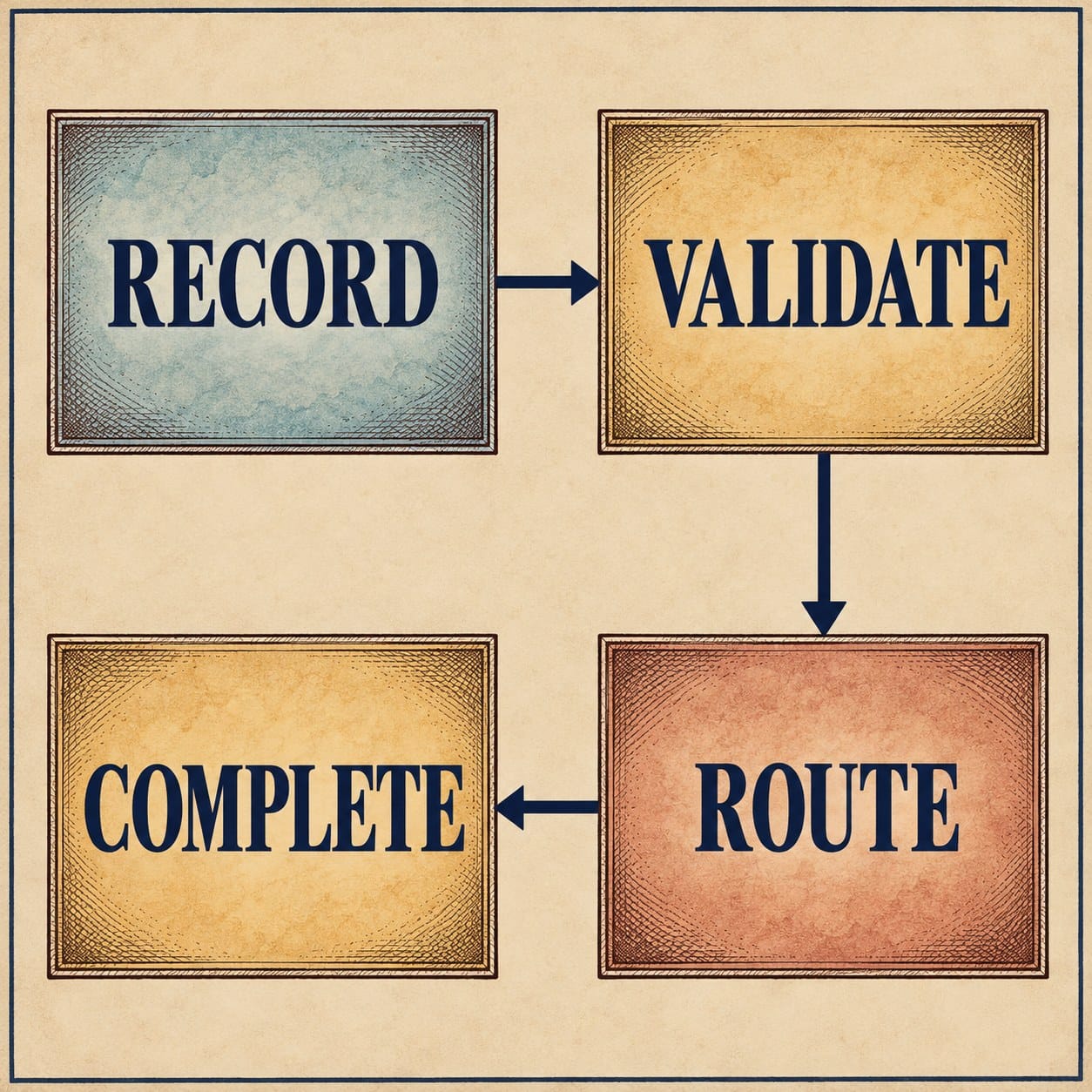
In practice, each stage represents an explicit contract:
- Record: Capturing unstructured discharge summaries, consultation notes, or specialist recommendations cleanly, preserving clinical nuance without creating manual clerical burdens.
- Validate: Running programmatic checks to verify that the clinical record contains all necessary elements for safe handoff, such as medication reconciliation, pending test results, and follow-up orders.
- Route: Assigning unambiguous operational ownership to a clinician, care coordinator, or specialist who possesses both the authority and the available schedule to act.
- Complete: Confirming that the patient actually received the necessary appointment, lab test, or medication, closing the loop rather than assuming an outbound message equals delivered care.
The integrity of this loop lies entirely in how it manages exceptions. When machine interpretation encounters ambiguous clinical notes, the system must escalate to human review rather than guessing. When critical discharge records are missing, the workflow must route an alert back to the discharging provider. When a specialist referral stalls without a scheduled visit, an escalation policy must alert clinical operations before weeks slip away. Deterministic code enforces states, permissions, and audit logs, while language models assist with extracting intent from messy prose.
This discipline reflects the principle of earning authority one capability at a time. In healthcare, an algorithm or agent should never be granted open-ended operational power. Autonomy must be earned by proving reliability against human operational baselines, tested on edge cases outside the happy path, and bounded by revocable permissions. When an automated workflow misinterprets a record or drops a handoff, that failure must become a regression test and a permanent guardrail across future runs, creating institutional memory that strengthens over time.
The real balance sheet
The financial ledger cannot be ignored. Healthcare leaders must rigorously account for software subscriptions, cloud compute, integration labor, staff retraining, and the ongoing operational cost of human oversight. Fiscal discipline and human-centered care are not warring ideals; they are mutual requirements for building sustainable institutions.
Torsten Slok's macroeconomic critique reminds us that capital investments must demonstrate tangible value. But evaluating healthcare AI purely through the lens of corporate operating margins or raw patient volume guarantees perverse incentives. If the only success metric is cramming more visits into a clinician's calendar, health systems will accelerate burnout while missing the patients who need continuous care the most.

Healthcare leaders have the power to define a more substantive return on investment. The real dividend of healthcare AI is measured when difficult diagnoses receive the unhurried attention they demand, when clinicians can close their laptops at the end of clinic and go home to their families, and when vulnerable patients leaving the hospital are reliably caught by care teams before complications arise. That is a higher standard of payoff, and it is the only one worthy of the profession.
A brief author note
If your organization is ready to move beyond generic automation and put AI to work toward dependable, human-centered clinical systems, Groktopus provides executive advisory and engineering strategy grounded in years of leading healthcare technology.