
Burn the Ships or Die of Legacy

Why Mutiny's 12x AI-Native Growth Exposes the Incumbent's Impossible Choice
The skunkworks model is the most seductive strategy in corporate innovation. It promises breakthrough without disruption. Spin up a small team. Give them autonomy. Let them build the future while the core business runs the present. Then hand off the magic and watch the company transform.
It almost never works that way.
The skunkworks faces a structural paradox that no amount of good intentions can resolve. The isolation that enables breakthrough innovation is the same isolation that causes the core business to reject it. The team builds something extraordinary. The company cannot absorb it. The breakthrough dies on the handoff table.
Mutiny showed the honest way out. It required something most CEOs cannot bring themselves to do.
The Canonical Template and Its Hidden Flaw
Lockheed's Skunk Works codified the model in 1943. Clarence "Kelly" Johnson delivered the XP-80 Shooting Star in 143 days. His 14 rules became the operating manual for high-stakes innovation. Complete control for the manager. Small teams, ten times smaller than conventional programs. Direct customer contact. Minimal reporting. Technical freedom. Strict information control. Be quick, be quiet, and be on time, as documented by Fly a Jet Fighter.
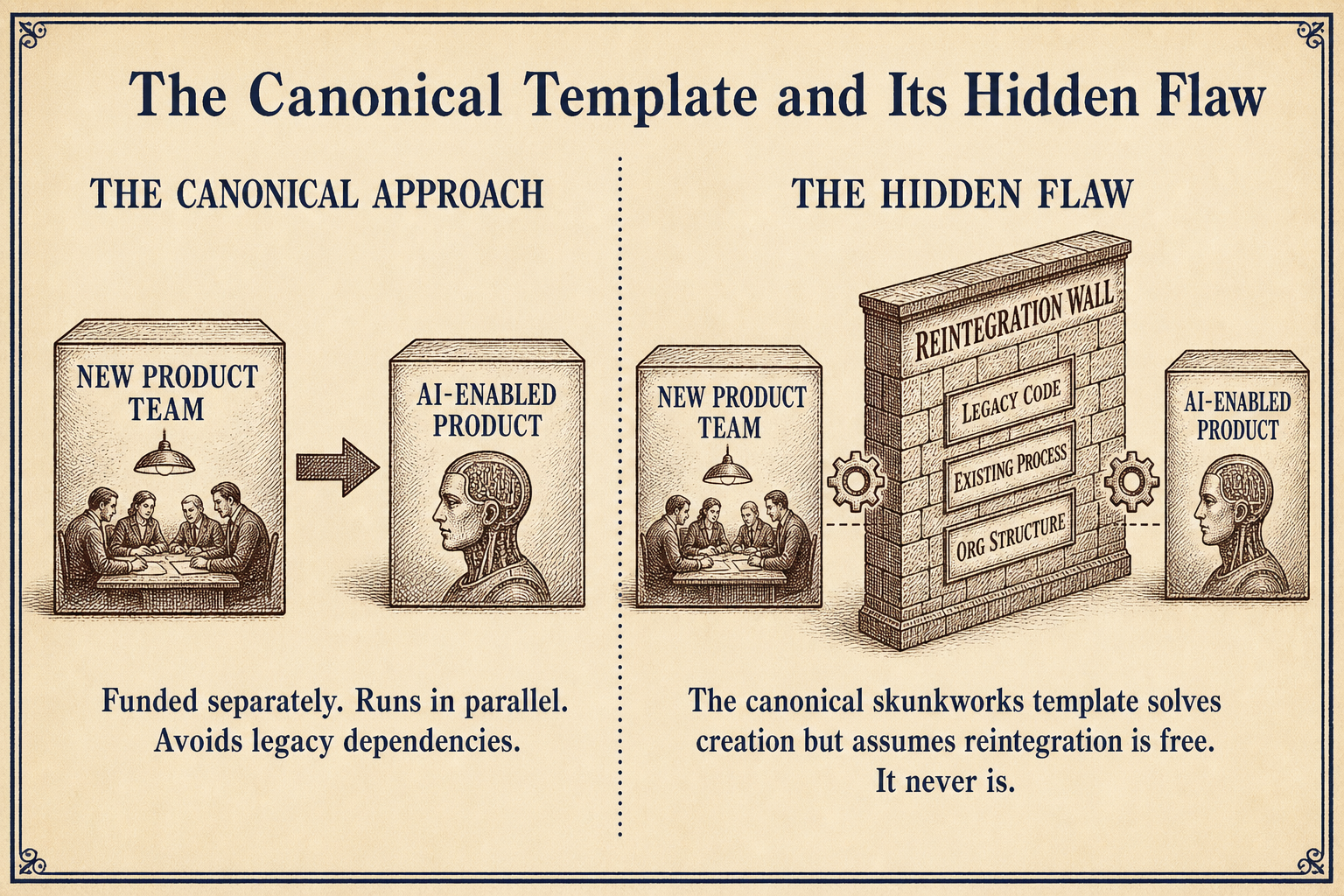
This worked because Lockheed's Skunk Works was not a skunkworks in the modern sense. It was an independent production unit. It did not need to hand off its output to a hostile core business. It designed, built, tested, and delivered aircraft directly to the customer. The reintegration problem did not exist.
Modern corporate skunkworks operate differently. They build prototypes, not production systems. They depend on the core business to scale, sell, and support what they create. That dependency is the trap.
Clayton Christensen diagnosed this trap in 1997. His Innovator's Dilemma showed that incumbents cannot pursue disruptive innovation within the core business. The core demands high margins. It serves existing customers. It requires predictable ROI. Disruptive innovation violates every filter, according to a Future Startup review of the book. Christensen's prescribed solution was the same as Johnson's: create an autonomous organization. Keep it separate. Give it independent resources.
Christensen was right about the diagnosis. He was optimistic about the cure.
The Reintegration Wall
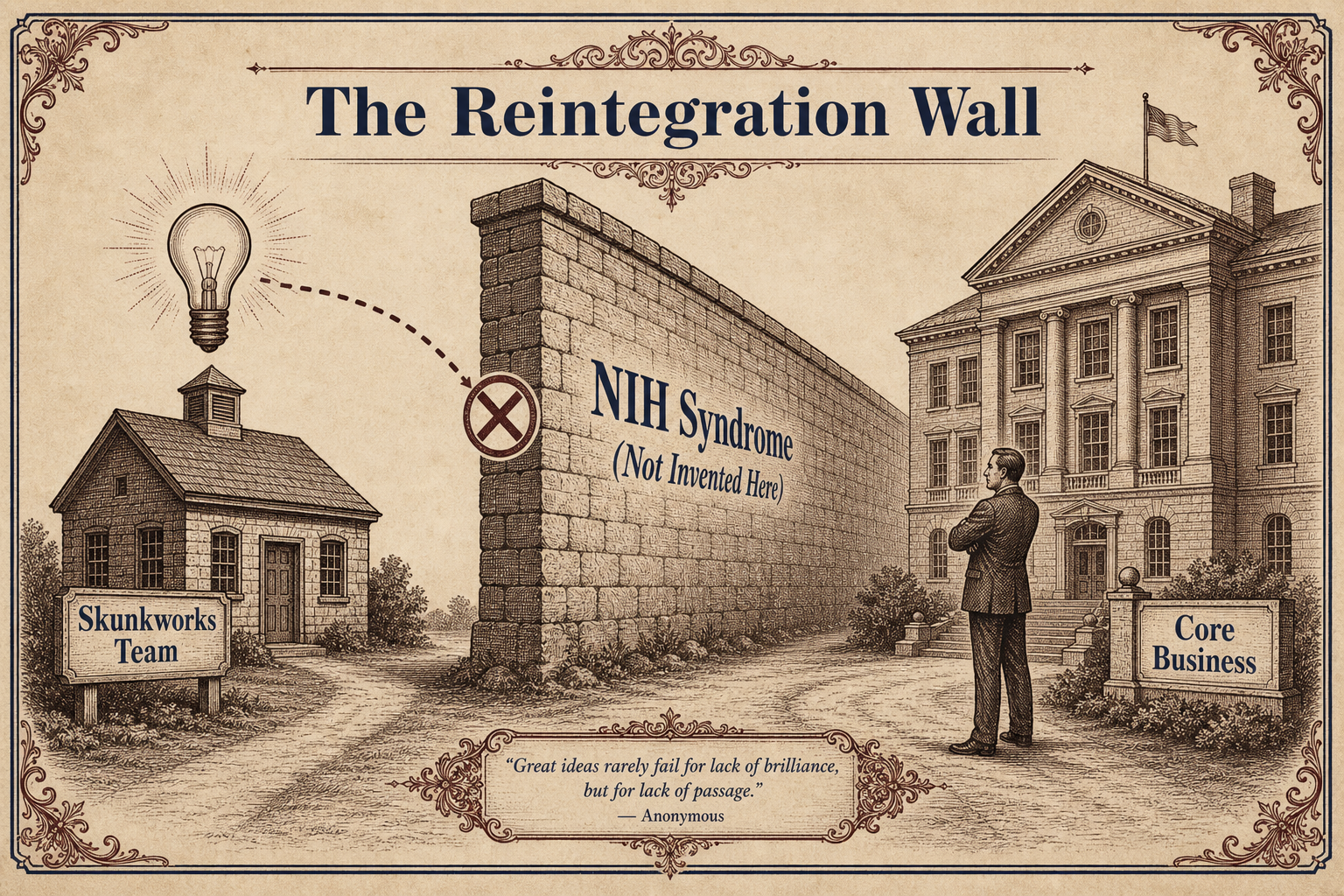
Steve Blank argued in 2014 that corporate skunkworks need to die. His reasoning was prescient. Skunkworks embodied innovation by exception, he wrote, but the 21st century demands innovation by design. Disruption is no longer rare. Companies must execute core products while continuously inventing new ones, as Steve Blank argued.
Blank identified the critical failure mode: even successful skunkworks breakthroughs die during handoff back to the core business. Xerox PARC invented the graphical user interface, the mouse, and Ethernet. Xerox commercialized none of them. Apple took the GUI. 3Com took Ethernet. PARC's isolation produced breakthroughs. PARC's isolation also prevented those breakthroughs from surviving inside Xerox, as detailed in Neurofied's analysis of the Xerox PARC case.
The mechanism is well understood. Katz and Allen documented it in 1982. R&D group performance declines after roughly five years of insularity. The "not invented here" syndrome is not a personality flaw. It is an organizational immune response, as documented by Katz and Allen in their 1982 study of R&D groups. Core business teams actively resist adopting skunkworks output because it threatens their expertise, their resource allocation, and their status.
The research on organizational ambidexterity offers mitigation strategies. Involve core business leaders early. Rotate staff between skunkworks and core. Incentivize adoption. These are sensible recommendations. They are also band-aids on a structural wound.
The statistics are brutal. A 2025 MIT report found that 95% of enterprise AI pilots deliver zero measurable P&L impact. Only two of nine major sectors show material business transformation from generative AI. Large firms lead in pilot volume but lag in successful deployment, according to the MIT report.
Stanford HAI research identified three determinants of AI project success. Jurisdictional clarity: is there a well-defined stakeholder group? Task centrality: does the AI solve a core daily problem? Task enactment: are processes uniform enough to scale? When these conditions are absent, failure is predictable, according to Stanford HAI research.
Most corporate skunkworks violate all three. They operate in organizational no-man's-land. They solve problems the core does not own. They produce output the core cannot absorb.
The Case That Proves the Rule
Mutiny was founded in 2018 by Jaleh Rezaei and Nikhil Mathew, both Gusto alumni. They built a no-code AI platform for B2B website personalization. Accepted into Y Combinator in 2018, they launched an MVP in two weeks and reached roughly $100K ARR within two months, as documented in the Y Combinator playbook for building AI-native companies.
By Series B in April 2022, Mutiny had raised $50M led by Insight Partners at a $600M valuation. Roughly 50 employees served 50 million people across 3 million companies, according to Insight Partners.
Then came the moment Diana Hu calls "burn the ships."
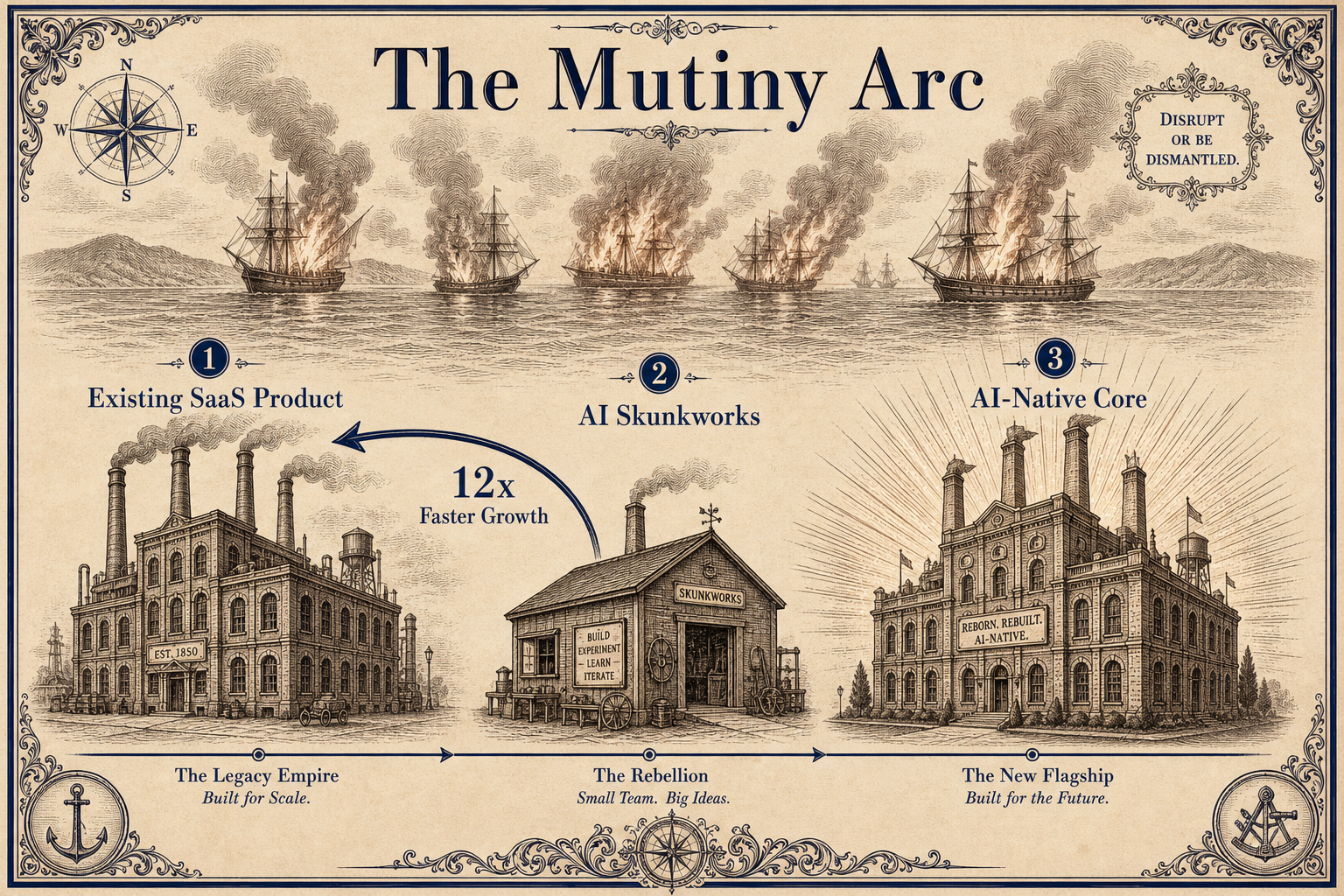
Mutiny realized its existing SaaS approach could not survive the AI transition. The company faced a choice. Continue optimizing the existing product and hope AI enhancements would be enough. Or build a completely new AI-native system from scratch and let it replace everything.
Rezaei chose the second path. Mutiny built an internal skunkworks team. They operated with startup speed despite being an established company. They avoided the "legacy tax" of maintaining the live product while trying to innovate.
The result: the AI-native system outperformed the existing product so dramatically that Mutiny Agents achieved 12x faster growth compared to the old SaaS approach, as described in Y Combinator's founder fireside chat with Mutiny. The skunkworks output did not reintegrate into the core. It replaced the core.
The Honest Solution
"Burn the ships" is the honest answer to the skunkworks paradox. Do not build a prototype that the core will reject. Build a replacement that makes the core obsolete. Accept that the bridge to the future requires burning the bridge to the past.
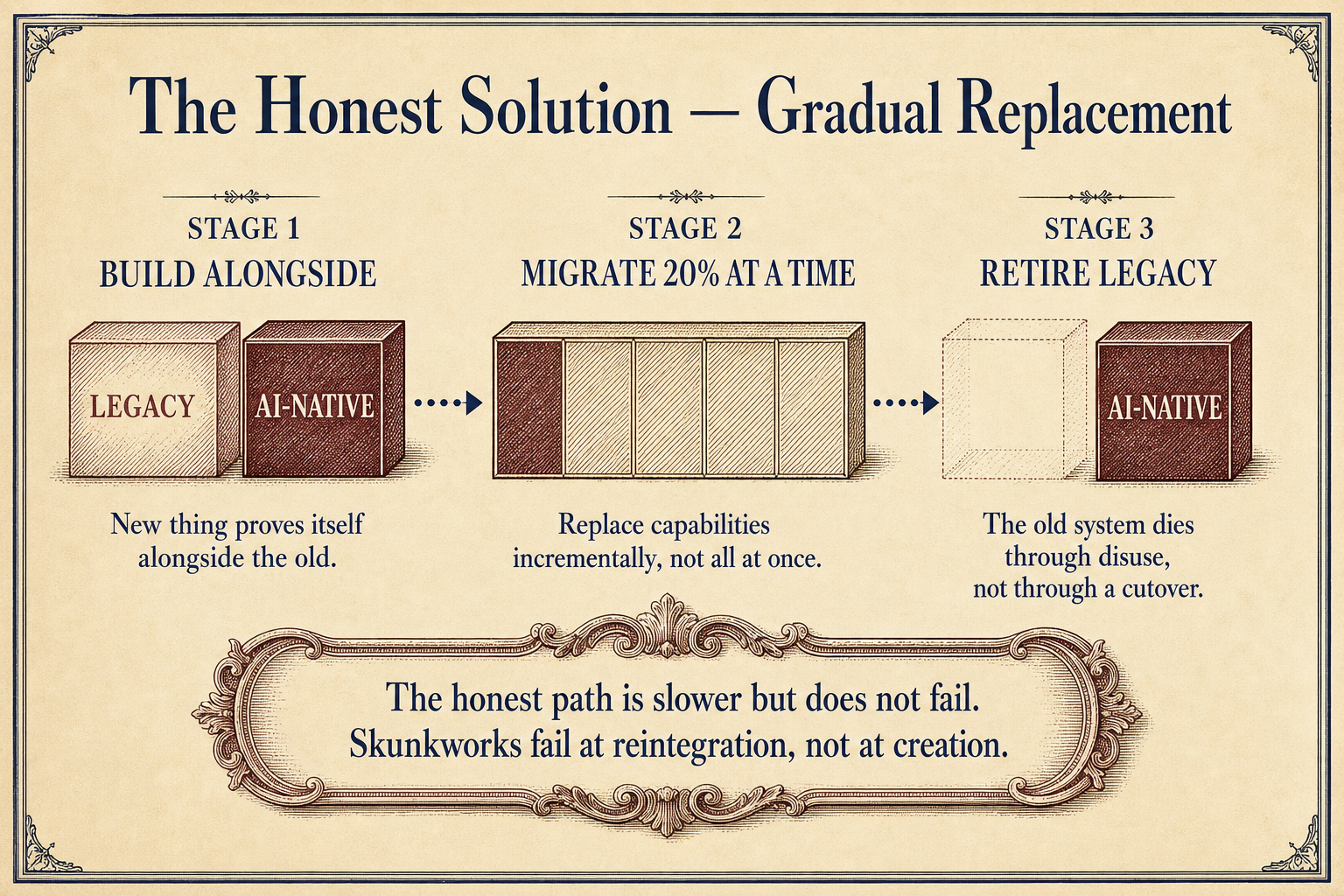
This is what Christensen's autonomous organization looks like when taken to its logical conclusion. Separation is not a staging ground for reintegration. Separation is the new reality. The skunkworks does not hand off. It takes over.
The conditions for this to work are demanding. First, the skunkworks must achieve orders-of-magnitude improvement, not incremental gains. Mutiny's 12x growth qualifies. A 20% improvement does not justify burning anything. Second, executive leadership must be willing to cannibalize existing revenue. This is not a boardroom abstraction. It means telling your most profitable business unit that its product is being replaced by a team of 50 people in a different building. Third, the company must accept that the transition will be chaotic. The core business does not gracefully wind down. It fights.
Most CEOs cannot execute this. The reasons are not stupidity or cowardice. They are rational responses to real incentives. The core business generates the revenue that pays for everything. The skunkworks generates only promise. The board evaluates on quarterly results. The "burn the ships" move produces negative short-term results before producing any long-term gains. The executive who greenlights this move is betting their career on a timeline that may exceed their tenure.
The numbers confirm this. The MIT/BCG study found that large firms lead in pilot volume but lag in deployment. They have the resources to explore. They lack the organizational courage to commit. The pilot is the safe move. The skunkworks is the safe move. Burning the ships is not safe.
The Tension Remains
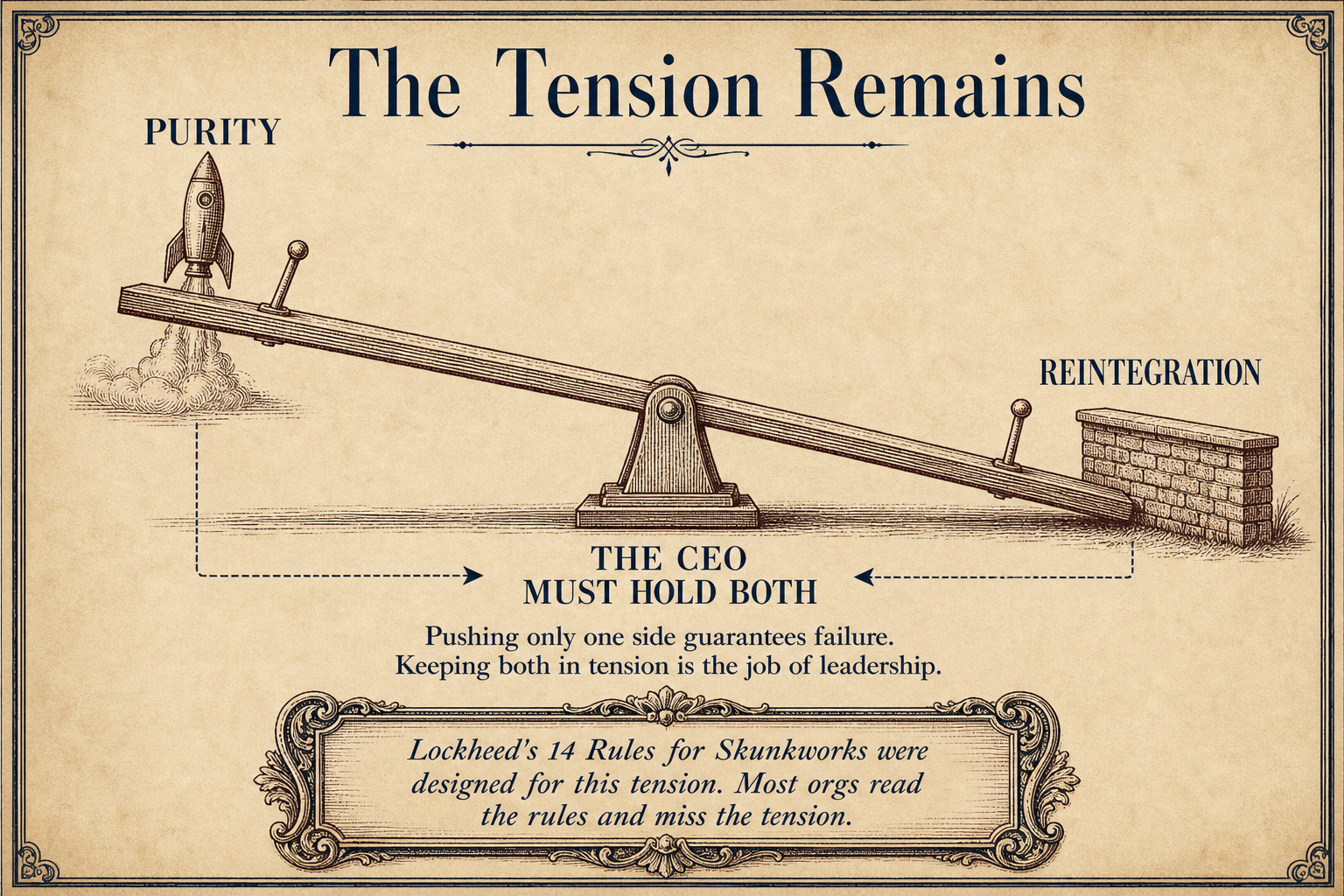
Steve Blank was right that skunkworks are an innovation-by-exception model in an era that demands innovation by design. But his alternative, continuous innovation integrated into the core, has its own failure mode. The core business that can continuously innovate does not need a skunkworks. And most core businesses cannot continuously innovate.
Stanford's three determinants help explain why. Jurisdictional clarity is absent in organizations where AI projects span multiple fiefdoms. Task centrality is low when the AI solves a problem the core does not own. Task enactment fails when processes are too variable to scale. These are not design flaws in the AI project. They are structural features of the incumbent organization.
The skunkworks solves the first problem by creating clear jurisdiction within its boundaries. It creates high centrality by focusing on a single, ambitious goal. It creates uniform processes by building from scratch. But it recreates the three problems at the organizational boundary. The skunkworks has clear jurisdiction. The core does not recognize it. The skunkworks solves a central problem. The core treats it as peripheral. The skunkworks has uniform processes. The core cannot run them.
This is the unresolved tension at the heart of the skunkworks model. Isolation enables breakthrough. Isolation causes reintegration failure. Every mitigation strategy that preserves isolation preserves the failure mode. Every strategy that reduces isolation reduces the breakthrough potential.
Mutiny's "burn the ships" cuts the knot rather than untangling it. It does not solve the reintegration problem. It eliminates the need for reintegration. The skunkworks becomes the core. The old core is discarded.
What This Means for Incumbents
The honest question for any CEO considering an AI skunkworks is not "can we build something great?" It is "are we willing to bet the company on the outcome?"
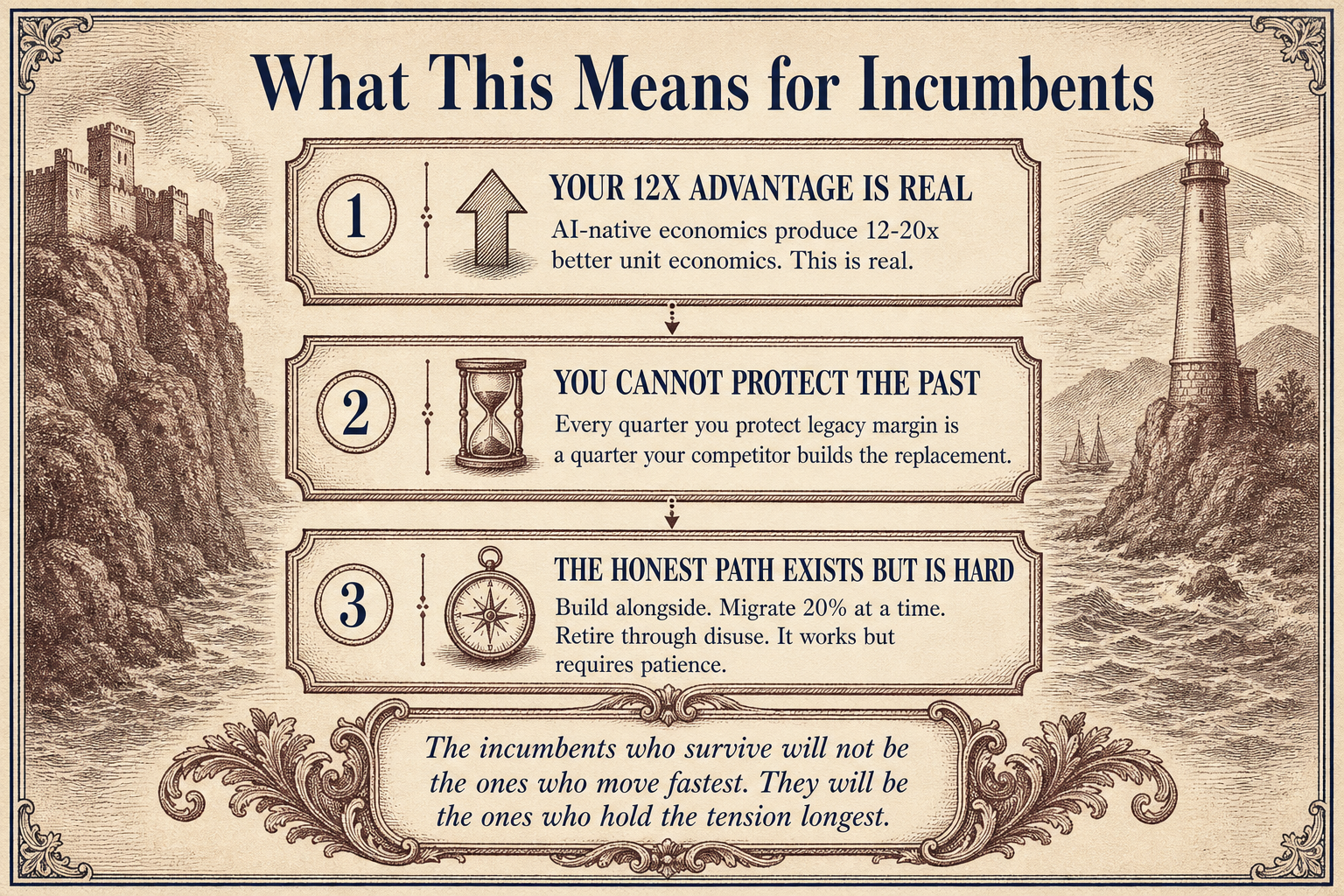
If the answer is no, the skunkworks will produce interesting prototypes that die on the handoff table. This is not failure in the conventional sense. The team will learn. The company will publish case studies. The pilot will be declared a success. Revenue will not change.
If the answer is yes, the skunkworks can produce something that transforms the company. But the path requires accepting what most management teams cannot accept. The core business must be treated as expendable. The people running it must understand that their work is being wound down. The metrics that govern the company must be replaced before the new system proves itself.
This is why most companies will choose the pilot. The pilot preserves options. It signals innovation without requiring sacrifice. It is safe, expensive, and ineffective.
Lockheed's Skunk Works worked because it did not need to reintegrate. It delivered directly to the customer. Mutiny's skunkworks worked because it replaced the core entirely. Every other skunkworks in between faces the same unresolved tension. Isolation enables breakthrough. Isolation prevents adoption.
The ships are going to burn either way. The only question is whether you set the fire on your own terms.
Magnus Hedemark writes about AI strategy, organizational transformation, and the uncomfortable choices that separate outcomes from intentions.
This article draws on Diana Hu's Y Combinator talk on building AI-native companies, Christensen's Innovator's Dilemma, and Steve Blank's critique of corporate skunkworks.