
Airbnb's AI Bet: Culture Before Cost-Cutting

Brian Chesky says shared models are table stakes. The real advantage is whether a company can turn model access into better work, better service, and a bigger ambition.
Airbnb says it has cut the time from concept to delivery by as much as 60 percent and increased the number of features and improvements it ships by nearly 80 percent year over year. Those are big numbers. The more consequential detail is the operating decision underneath them: Airbnb says it’s using artificial intelligence (AI) to expand what its existing workforce can accomplish. Its second-quarter 2026 results make that claim directly.
That makes Airbnb a useful case study in the AI operating shift. The company has used machine learning for years. What changed is the scope: AI moved from individual products into a company-wide capacity strategy.
The unresolved question is the one that matters most to people doing the work: where did the recovered capacity go?
The model is not the moat
Airbnb's own technology history complicates the usual AI story. The company says it began building machine-learning models for search and discovery in 2013. It now says every reservation interacts with machine-learning or AI technology, including systems for search, fraud prevention, and host pricing. This is an old and deeply embedded product capability. The current generative-AI push sits on top of it.
The newer shift is organizational. Airbnb acquired the 12-person GamePlanner.AI team in 2023 to accelerate selected AI projects and bring its tools into the platform, while describing the company as already using large language models, computer-vision models, and machine learning. The acquisition announcement framed the work as an intersection of AI, design, and community. In January 2026, Airbnb appointed Ahmad Al-Dahle, formerly Meta's head of generative AI, as chief technology officer. Airbnb described the appointment as part of an effort to shape travel and interaction with AI in ways that strengthen human connection and draw people into the physical world.
“I think the winners of AI aren’t the people that are most advanced technically. They’re most advanced culturally. I hope that makes sense. In other words, we all have access to the same technology. Like Airbnb and every one of our competitors and everyone that is on stage, especially in consumer, we all have the same model. The question is who has the culture to adapt quickly.”
Brian Chesky, Airbnb co-founder and CEO
The competitive claim is about application. At his September 8, 2026 Goldman Sachs Communacopia + Technology Conference appearance, Chesky put the competitive problem this way: “I think the winners of AI aren’t the people that are most advanced technically. They’re most advanced culturally. I hope that makes sense. In other words, we all have access to the same technology. Like Airbnb and every one of our competitors and everyone that is on stage, especially in consumer, we all have the same model. The question is who has the culture to adapt quickly.” The wording appears in a transcript rendering rather than an official stenographic record. CNBC's contemporaneous interview corroborates the broader argument.
This is the model-available era. Many companies can rent comparable foundation models. The scarce asset is the conversion layer around them: priorities, workflows, permissions, product judgment, data practices, experimentation, and the confidence to change how work gets done.
Airbnb's older technology page describes that layer in plainer terms. Its engineering culture emphasizes autonomy, data, experimentation, and diversity, and its teams combine data science, research, engineering, and product design. Those organizational choices predate the current model cycle. They now face a stress test as the cost of producing a first draft, prototype, search result, or support recommendation falls sharply.

The cultural claim is easy to turn into executive wallpaper. Test it with concrete questions: Who can try a new workflow? Who can challenge a model's answer? Who owns the customer outcome when the system is wrong? What happens to the time that used to disappear into routine work?
What Airbnb says it changed
Airbnb's public evidence is strongest when it describes changed work. In its first-quarter 2026 results, the company said nearly 60 percent of the code its engineers produced was coauthored with AI, roughly twice the industry average by Airbnb's estimate. It also said more than 40 percent of issues that began with its AI Assistant were resolved without a human agent, up from roughly a third in the fourth quarter of 2025. These are Airbnb-reported figures, not independently audited benchmarks.
By the second quarter, Airbnb said it had reduced concept-to-delivery time by as much as 60 percent and increased shipped features and improvements by nearly 80 percent compared with the same period a year earlier. It also reported that nearly 45 percent of issues beginning with the AI Assistant were resolved without a human agent, while customer-support-related cost per booking fell approximately 16 percent year over year, driven in part by improvements to the assistant. The company's Q2 release gives the denominator and timeframe, which makes the claims easier to evaluate.
The support example shows what capacity expansion can look like in practice. Airbnb first described the rollout in Q4 2025 for English, French, and Spanish-speaking users in the United States, Canada, and Mexico. Its Q4 results said about a third of issues were resolved without an agent when users messaged the assistant. By Airbnb's 2026 Summer Release, the assistant was described as available in more than 50 languages, with interactive cards and a planned voice extension. The release also described AI-generated review highlights and home comparisons, which move the system beyond a generic help chatbot and into the decisions people make while planning a trip.
The internal operating story is broader. In an August 7, 2026 interview with CNBC, Chesky said Airbnb tracks individual token usage as one adoption measure but considers it crude, focusing more heavily on team output. He said the gains began with engineering and spread into product management, design, marketing, and creative services. CNBC reported those remarks alongside the company's roughly flat headcount and higher AI spending.
The scoreboard is straightforward. Token usage is an input. Shipped improvements, completed bookings, resolved cases, useful host tools, and customer trust are closer to outcomes. Quality, workload, and pace need to be measured alongside them.
The user-facing boundary matters too. Airbnb's AI-features help page says users can control whether their personal information is used to develop and improve the models behind search and personalization. The public help documentation doesn't answer every privacy question, but it makes control visible. Internal speed is not a complete measure of responsible adoption if external control remains opaque.
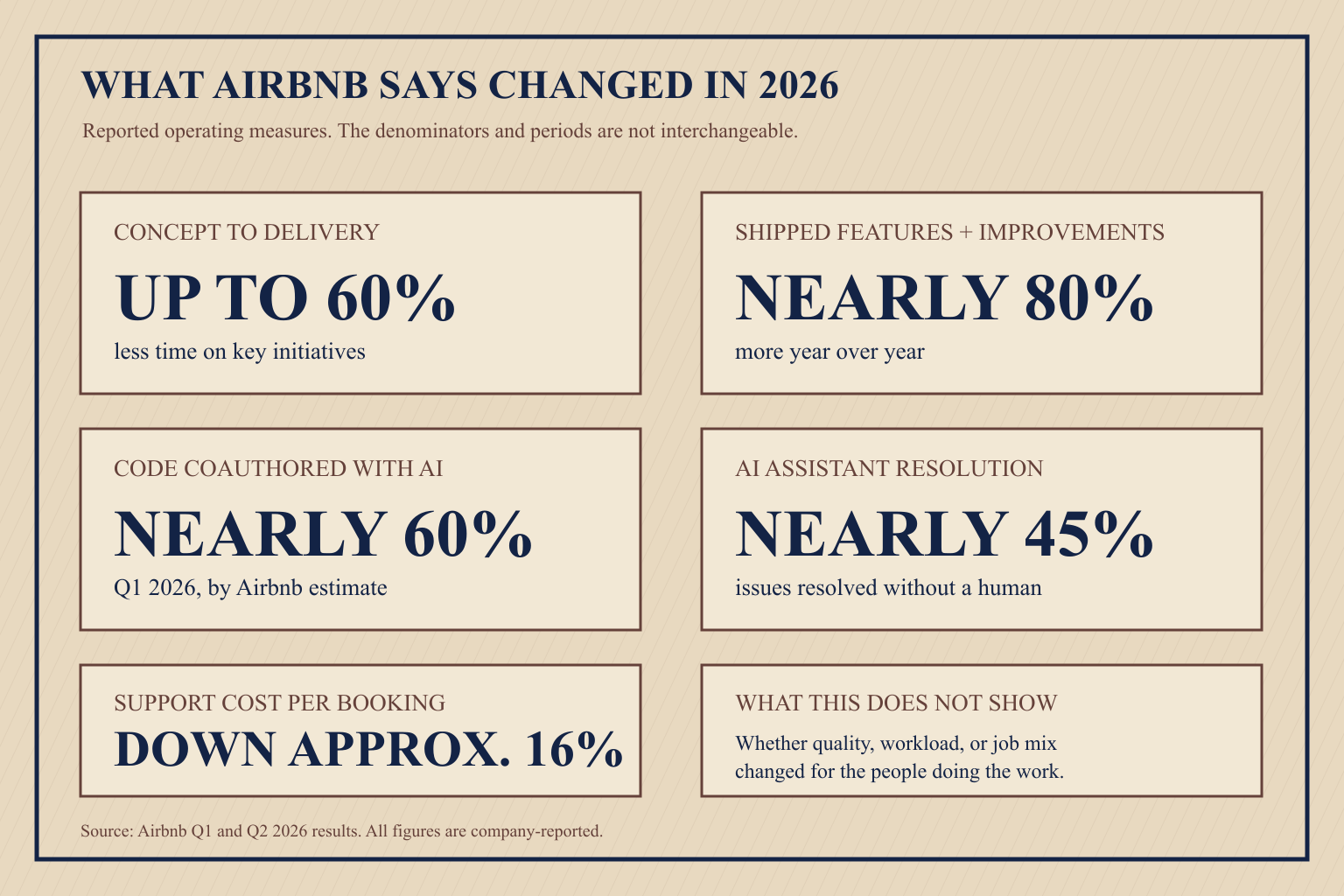
The numbers still need restraint. Nearly 60 percent code coauthorship describes how engineers are working; it says less about the amount or quality of engineering work. The 45 percent resolution rate covers cases that begin with the assistant, so it cannot stand in for all support demand. The 16 percent cost-per-booking decline may have several causes, including assistant improvements. Airbnb has shown what it measures and what it wants investors to notice. Employees' experience remains unreported.
The workforce story is harder to prove
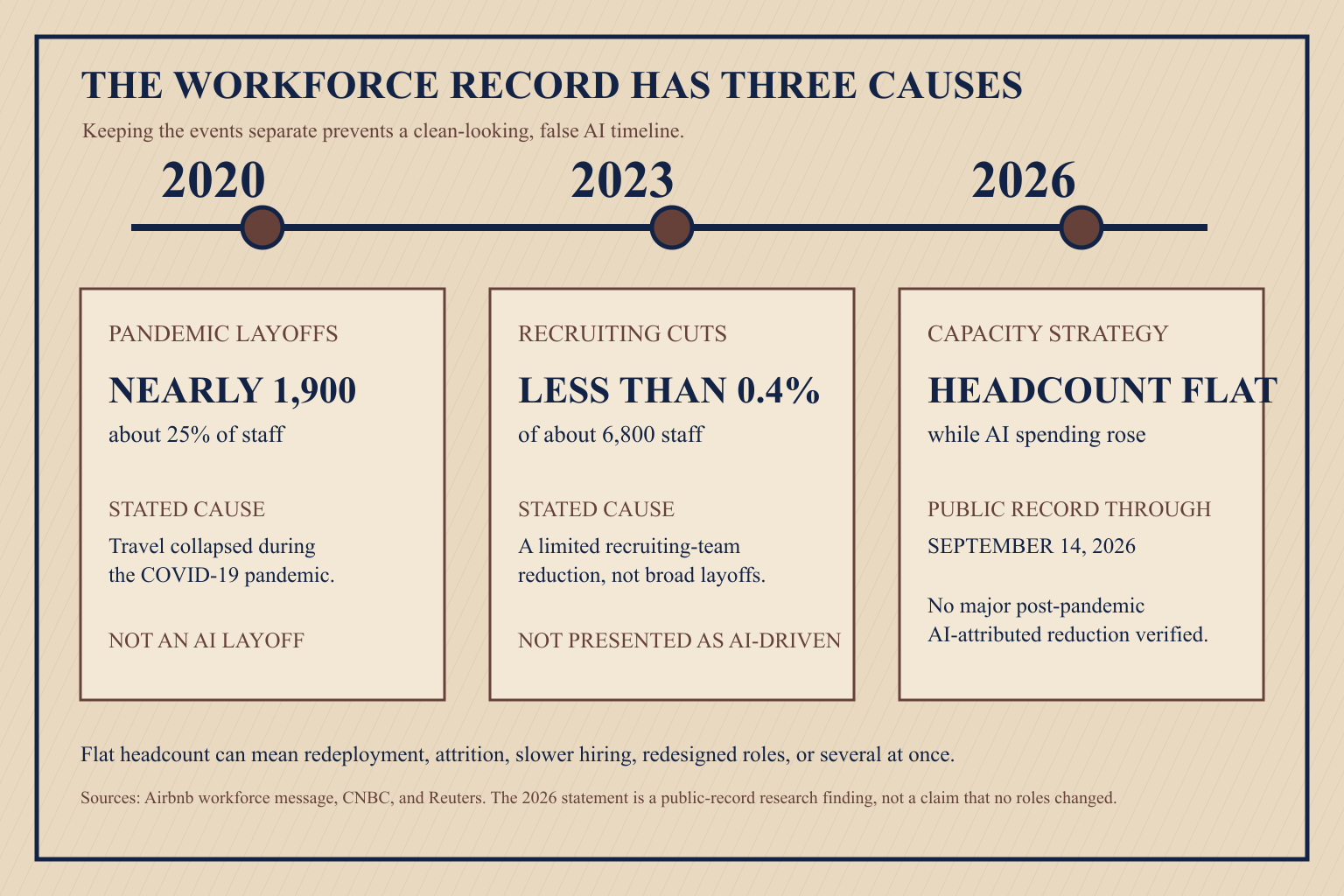
Airbnb has made major workforce changes before. In May 2020, as the pandemic brought global travel close to a standstill, Chesky wrote that nearly 1,900 of Airbnb's 7,500 employees would leave, about 25 percent of the company. His workforce message tied the decision to a revenue forecast of less than half of 2019 levels and described paused or reduced investments in several businesses. CNBC's contemporaneous report likewise described the cuts as a consequence of the coronavirus collapse in travel. The stated cause was the pandemic, not AI.
In March 2023, Airbnb cut some recruiting staff. CNBC reported that the change affected less than 0.4 percent of a workforce of about 6,800, and that a company spokesperson said it was not an indication of more widespread layoffs. The CNBC report also noted that Airbnb expected headcount growth of 2 to 4 percent that year, down from 11 percent in 2022. This was a small recruiting reduction alongside a slower hiring plan. The report did not tie either decision to an AI-led workforce strategy.
“Our philosophy has been not necessarily to use AI to have fewer people, but to use AI to get more out of the people.”
Brian Chesky, Airbnb co-founder and CEO
The 2026 picture is different again. CNBC reported that headcount was roughly flat even as AI spending rose, and quoted Chesky's philosophy as: “Our philosophy has been not necessarily to use AI to have fewer people, but to use AI to get more out of the people.” The statement describes a management objective. It leaves the fate of particular jobs and roles unresolved.
The public record through September 14, 2026 does not show a major post-pandemic Airbnb workforce reduction explicitly attributed to AI. It leaves several possibilities open: Airbnb may have held back hiring, relied on attrition, redesigned roles, consolidated work, or backfilled fewer departures.
Flat headcount can reflect redeployment, higher output from the same staff, slower hiring, natural attrition, or a higher bar for replacing departures. Several may be true at once. This ambiguity sits at the center of human-centered AI transformation. If output rises while staffing stays roughly steady, the public still needs to know whether the gain became more useful work, better work, or a heavier workload.
Where did Airbnb's recovered capacity go?
The 2026 product releases offer clues. They show a wider surface area: better search, review summaries, home comparisons, support automation, services, experiences, hotels, and tools for hosts. The Q2 release describes dozens of guest and host improvements, while the Summer Release presents AI as part of the end-to-end trip rather than as a standalone chatbot.
The evidence may indicate capacity expansion, but the public record does not connect each new product or cost saving to a measured pool of recovered employee time. The company hasn’t published a capacity ledger that says: this much time came from coding assistance, this much from support automation, and this much went into better search, product research, quality, learning, or customer care.
Potential destinations include:
- More useful products and more ambitious growth. Airbnb can pursue more experiments and more categories without increasing staff at the same rate, then reinvest operating leverage into product, marketing, technology, international expansion, and new services. Airbnb's 2026 outlook describes continued investment in AI and growth initiatives.
- Better service. Support specialists may spend more time on complex, emotional, or high-value cases while the assistant handles routine requests. Chesky described that direction in the conference transcript, but the public evidence still lacks a before-and-after quality measure for the human work.
- Higher expectations. The same workforce may be expected to ship more, respond faster, and absorb more oversight. That risk belongs in any capacity-expansion scorecard, even though Airbnb has not reported it.
- Fewer future opportunities. Even without a headline layoff, slower hiring or redesigned entry-level work can change who gets a first chance to learn the business. Airbnb hasn’t publicly disclosed enough role-level data to resolve that question.
The comparison helps because other companies have made the trade-off explicit. Ask what each chose to fund, and who paid for it.
In March 2026, Atlassian co-CEO Mike Cannon-Brookes announced a reduction of about 10 percent, or roughly 1,600 employees. He wrote that Atlassian was doing it “to self-fund further investment in AI and enterprise sales,” then added: “But it would be disingenuous to pretend AI doesn’t change the mix of skills we need or the number of roles required in certain areas. It does.” Atlassian's own team update is unusually clear about the connection it draws between workforce reduction and AI investment.
Amazon's language is more forward-looking. In a June 2025 letter, CEO Andy Jassy wrote: “We will need fewer people doing some of the jobs that are being done today, and more people doing other types of jobs.” He continued: “In the next few years, we expect that this will reduce our total corporate workforce as we get efficiency gains from using AI extensively across the company.” Amazon published the statement itself. Amazon is describing an expected contraction in some corporate roles. The forecast still awaits workforce-level results.
Airbnb proposes flat headcount and higher output. Atlassian ties workforce reduction to AI and enterprise-sales investment. Amazon anticipates fewer people in some jobs and a smaller corporate workforce over time. Those choices are explicit. What remains to measure is who benefits, who bears the transition cost, and where the capacity goes.

Airbnb's case offers a serious alternative to headcount subtraction as the default corporate use of AI. The evidence shows wider product activity, more automation, and roughly flat headcount. It does not show how those gains affected employees.
Shared models make culture central. Airbnb's advantage will depend on what its people are allowed and equipped to do with them. Until the company publishes that accounting, its culture thesis remains a management experiment under observation.